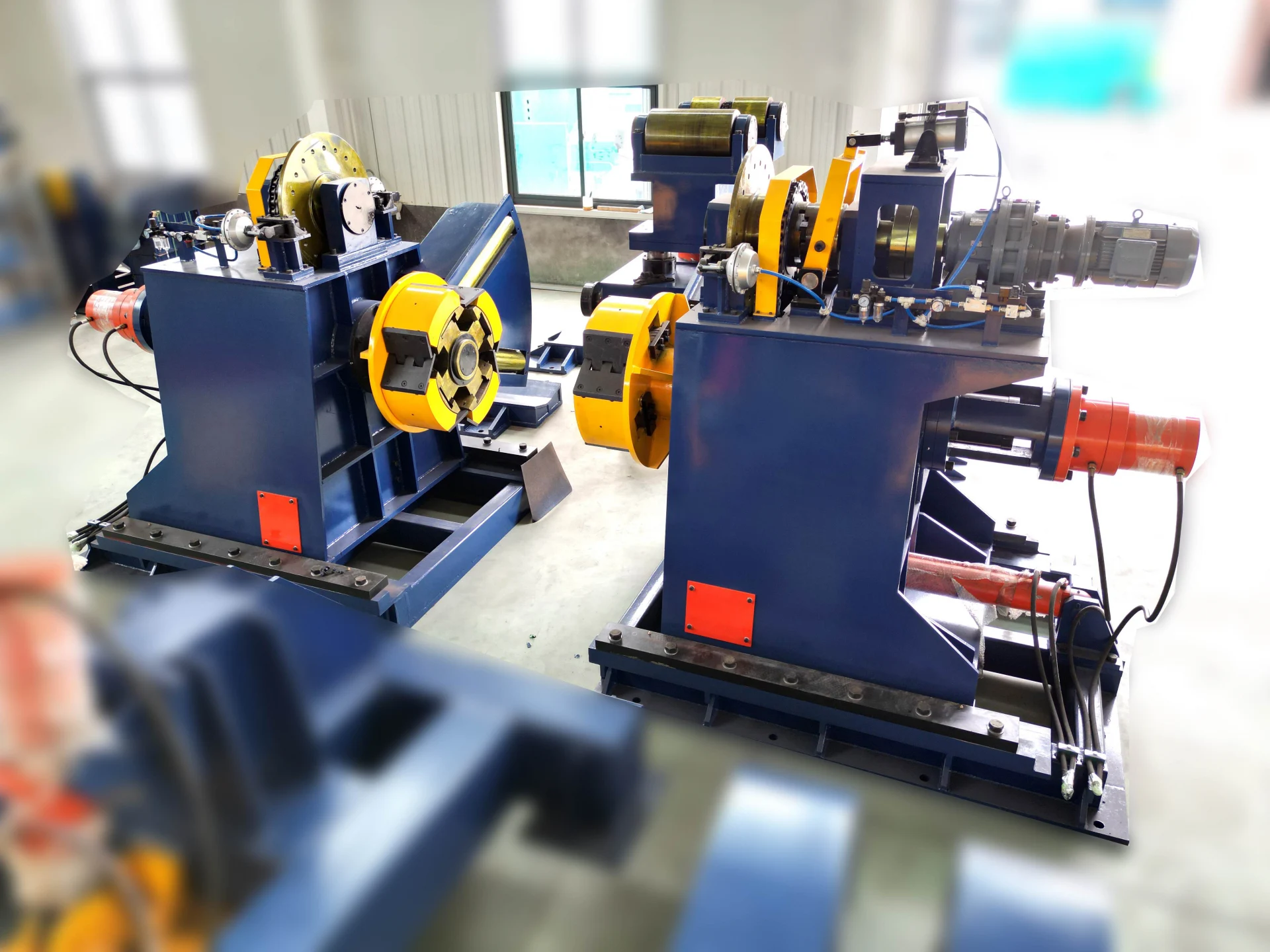
Decoiler and Straightener Calibration: How to Eliminate Coil Set, Camber & Edge Wave
Quick Answer: A decoiler and straightener removes residual curvature (coil set and crossbow) from wound steel coils by flexing the strip beyond its elastic yield limit through alternating upper and lower hardened rolls. Proper calibration sets deep roll penetration at the entry pair (70%–80% thickness yielding) tapering linearly to a light kiss-pass at the exit roll—delivering dead-flat strip (≤ 0.5 mm/m) that prevents weld-seam mismatch and fin-pass roll wear in ERW tube mills.
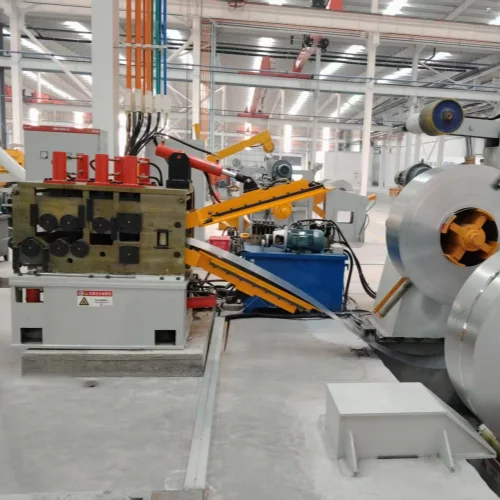
Why Coil Set Ruins High-Frequency ERW Tube Welding
When hot-rolled or cold-rolled steel is wound onto a 508 mm mandrel at the steel mill, the inner wraps experience severe plastic bending strain. When uncoiled onto your tube mill or stamping line, that strip retains strong memory curvature known as coil set—and the curvature grows progressively tighter as you approach the inner core of the coil.
If curved strip enters a shear and end welder or ERW breakdown forming stand without proper leveling, three costly defects occur immediately:
- Butt-Weld Step Mismatch: Curved coil tails fail to clamp flat against the next coil head, producing weak end welds that snap inside the strip accumulator.
- Asymmetric Fin-Pass Entry: Residual coil curvature causes one strip edge to ride higher than the other at the HF weld V-apex, triggering cold welds, edge overlap, and excessive ID/OD scarfing waste.
- Twisted Square & Rectangular Tubes: In a direct forming square tube mill, unreleased residual stress manifests as longitudinal bow and diamond twist after the flying cut-off saw releases the pipe.
The Physics of Reverse-Bending Strip Straightening
A pinch and leveling machine (or integrated 3-in-1 decoiler straightener feeder) does not flatten steel by crushing it vertically; instead, it forces the strip through a series of progressively smaller alternating S-bends. At the first upper work roll, both outer surfaces of the strip are pushed past the material's yield strength (typically 235–550 MPa) so internal residual stresses reset symmetrically. Each subsequent roll applies a smaller reverse bend until the strip exits stress-balanced and flat.

Step-by-Step Decoiler and Straightener Calibration Procedure
Follow this repeatable 5-step engineering procedure whenever changing strip thickness or steel grade:
5-Step Precision Roll Calibration Protocol
- Establish True Zero Reference: Clean all rolls, lower the upper roll bank onto precision gauge blocks matching the roll gap zero mark, and zero all dial indicators (0.05 mm resolution) on both operator and drive sides.
- Set Entry Roll Penetration: Set the entry upper roll gap to
Strip Thickness (t) minus 1.5 mm to 3.0 mm(deeper for thinner high-yield steel; shallower for thick mild plate). Verify left and right dial indicators match within ±0.05 mm to avoid inducing camber. - Set Exit Roll to Kiss-Pass: Position the final exit upper roll at
Strip Thickness (t) plus 0.1 mm to 0.2 mmso it acts strictly as a flat reference tangent without re-bending the strip downward. - Run a 2-Meter Flatness Coupon: Jog 2 meters of strip through the straightener, lay it freely on a flat granite or machined steel inspection table, and measure bow.
- Fine-Tune Based on Residual Curve: If the strip still curls in the original coil direction, increase entry penetration by 0.25 mm increments. If the strip curls in the opposite (reverse) direction, back off the exit roll by 0.20 mm increments.
Matching Roll Count & Diameter to Strip Thickness
A frequent purchasing error is selecting a 5-roll heavy-plate flattener to run thin 0.8 mm galvanized sheet—or vice versa. Roll diameter determines maximum bending curvature: smaller, tightly spaced rolls with backup support are required to yield thin, high-strength steel, whereas large-diameter rolls prevent deflection under thick hot-rolled coils.
| Strip Thickness Range | Recommended Work Rolls | Typical Roll Diameter | Backup Roll Support | Target Flatness |
|---|---|---|---|---|
| 0.4 – 2.0 mm (Cold Rolled / GI) | 9 to 11 rolls (or 17-roll CTL leveler) | Ø45 – Ø65 mm | Required (full-width backup banks) | ≤ 0.5 mm / m |
| 1.5 – 4.5 mm (ERW32–ERW89) | 7 rolls (4 upper / 3 lower) | Ø75 – Ø95 mm | Recommended for high-strength Q355 | ≤ 0.8 mm / m |
| 4.0 – 8.0 mm (ERW114–ERW219) | 5 to 7 rolls heavy-duty | Ø110 – Ø140 mm | Required for wide coils (>600 mm) | ≤ 1.0 mm / m |
| 8.0 – 14.0 mm (API / ERW426) | 5 rolls ultra-heavy pinch & flattener | Ø160 – Ø220 mm | Hydraulic cylinder clamping | ≤ 1.5 mm / m |
Troubleshooting 4 Common Strip Straightening Defects
Induced Strip Camber
Cause: Uneven left-vs-right roll gap or worn side guide rollers.
Fix: Re-zero both side dial indicators with feeler gauges and align entry edge guides symmetrically to the mill centerline.
Surface Roll Marks / Indents
Cause: Weld spatter, mill scale, or dirt embedded on work rolls.
Fix: Install felt oil wipers on upper/lower rolls and specify hard-chrome plated GCr15 rolls (HRC 58–62).
Mid-Coil Flatness Drift
Cause: Tighter inner-core coil set as coil OD shrinks below 800 mm.
Fix: Log a 2-stage dial recipe (Outer Half vs. Inner Core) or upgrade to motorized servo-gap adjustment via HMI.
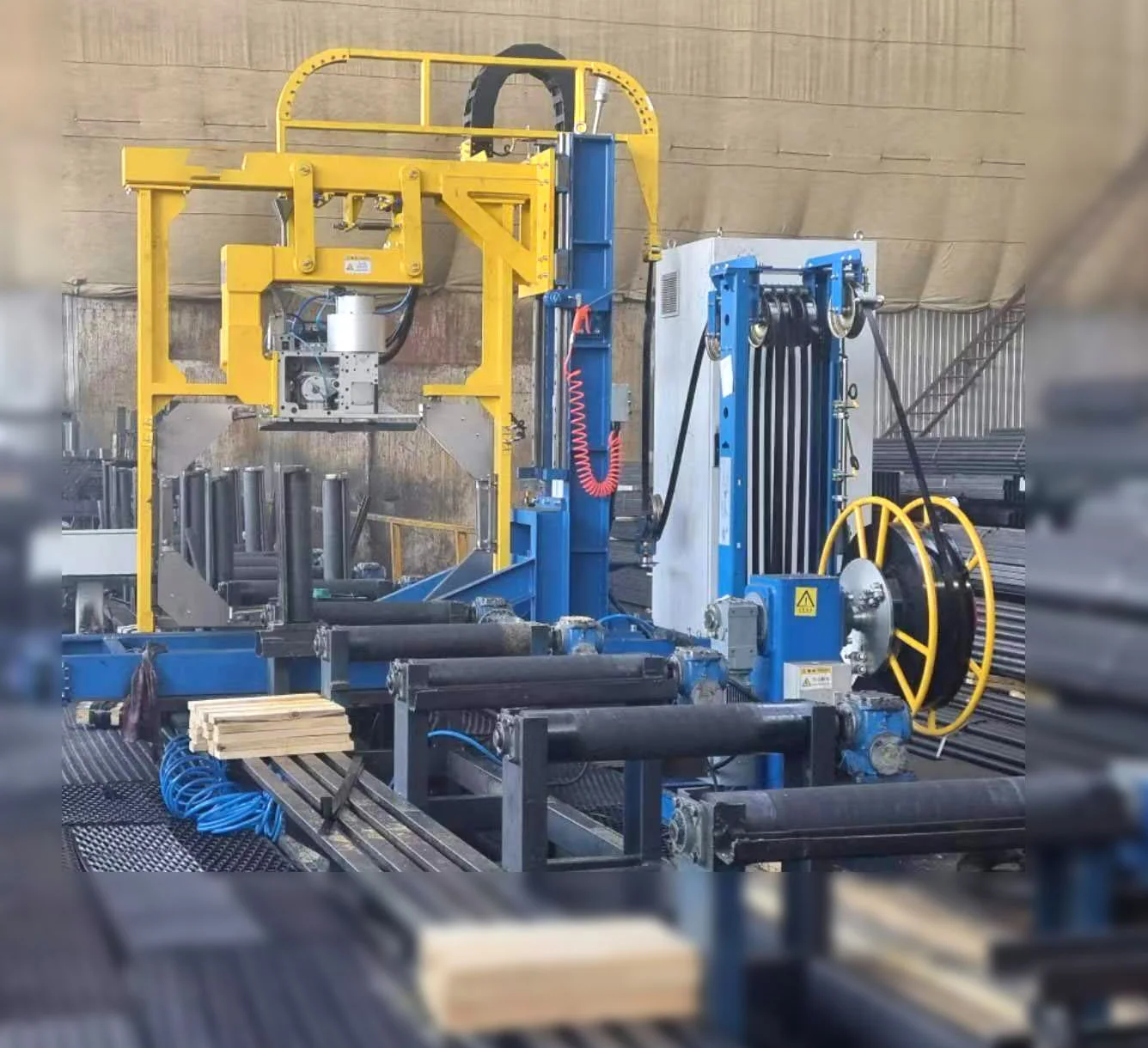
Critical Engineering Limit: Can a Straightener Fix Edge Wave or Center Buckle?
A standard 5-to-7 roll decoiler straightener removes coil set and mild crossbow, but cannot stretch localized long edges (edge wave) or center buckle—those shape defects require a multi-roll tension/precision leveler with individually adjustable backup flights (such as SANSO's 17/19-roll cut-to-length leveler).
Yielding Strain Physics: Calculating Roll Penetration Depth by Material Grade
Why do two strips of identical 2.0 mm thickness require completely different roll gap settings on the same decoiler and straightener? Because plastic leveling depends on the ratio of yield strength (σ_y) to elastic modulus (E). According to metallurgical forming principles documented by ASM International, high-strength structural steel (Q355B / S355, σ_y = 355 MPa) exhibits 50% more elastic springback than mild commercial steel (Q235 / A36, σ_y = 235 MPa), meaning the entry work rolls must bend it to a noticeably tighter radius to force 75%–80% of cross-sectional thickness into the plastic zone.
Worked Engineering Example: Minimum Bending Radius & Penetration Estimation
- Minimum Yield Radius Formula:
R_yield = (E × t) / (2 × σ_y), whereE = 210,000 MPafor carbon steel. - Case 1 — Mild Steel Q235 (t = 2.0 mm, σ_y = 235 MPa): Elastic-plastic transition occurs at
R_yield = (210,000 × 2.0) / 470 = 894 mm. To plasticize 75% of strip thickness, entry rolls must bend the strip to roughlyR_target ≈ 220–260 mm(approx. 1.6 mm entry penetration below pass line). - Case 2 — High-Strength Q355B (t = 2.0 mm, σ_y = 355 MPa): Transition radius shrinks to
R_yield = 592 mm; plasticizing 75% of thickness demands a tighterR_target ≈ 145–175 mm(approx. 2.4–2.8 mm entry penetration), requiring smaller-diameter rolls (Ø65–Ø75 mm) backed by stiff support bearings to avoid roll bow. - Engineering Lesson: If roll diameter exceeds
40 × strip thicknesson high-yield thin steel, the strip wraps around the roll elastically and springs right back to its original coil curve—no matter how hard you crank down the jack screws.
Complete Straightener Calibration & Preventive Maintenance Schedule
Even the finest precision straightener loses repeatability if worm-gear screw jacks wear unevenly or mill scale cakes onto backup bearings. Implement this structured maintenance routine across every ERW or stamping entry line:
| Interval | Inspection / Service Action | Target Engineering Standard | Consequence If Neglected |
|---|---|---|---|
| Every Shift | Wipe work rolls & entry felt wipers; verify dial indicator zero against strip recipe | Zero scale/grit embedded on chrome roll faces | Repeating dent marks every 250–300 mm along finished tube OD |
| Weekly | Check side-guide roller parallelism and pinch-roll pneumatic clamping pressure | Equal left/right cylinder pressure (0.45–0.6 MPa) | Strip skewing, induced camber, and uneven fin-pass wear |
| Monthly | Grease universal joint cardan shafts, worm-gear screw jacks, and needle bearings | EP-2 lithium grease purge without overheating (<65°C) | Seized upper roll adjustment screws & asymmetric roll gap |
| Quarterly | Verify left-to-right roll parallelism using precision feeler gauges & ground test bar | Left/right gap delta ≤ 0.05 mm across full roll width | Chronic strip saber/camber that twists ERW weld seams |
| Annually | Inspect hard-chrome plating thickness (≥0.08 mm) and measure bearing radial play | Work roll cylindrical runout ≤ 0.02 mm TIR | Chatter ripples on cold-rolled and galvanized strips |
Pre-Leveling vs. Inline ERW Pinch-Leveling: Choosing the Right Layout
Plant managers frequently ask whether to install a standalone heavy-duty pinch and leveling machine or an integrated 3-in-1 decoiler straightener feeder. Use these workshop layout criteria:
- Choose Standalone Uncoiler + Pinch-Leveler: Best for high-speed ERW tube mills (ERW76–ERW426) running continuous strip accumulators. Separating the uncoiler and pinch-leveler allows easy integration of a 180° double-head turnstile uncoiler and hydraulic peeler table so coil loading never interferes with leveling roll alignment.
- Choose Integrated 3-in-1 Decoiler Straightener Feeder: Ideal for stamping press lines, C/Z purlin roll formers, and compact light-gauge tube plants (ERW16–ERW50) where factory floor length is tight. Eliminating the 3–4 meter free catenary loop pit saves up to 50% of entry floor space and enables automated single-button coil threading.
FAT Inspection Criteria Before Accepting Your Straightener
During factory testing prior to shipment, run a full-width coil of your highest-yield steel grade (e.g., Q355B or 304 stainless) through the straightener at rated line speed. Lay three consecutive 2-meter test strips from outer, middle, and inner coil wraps on a machined surface plate: longitudinal bow must stay within ≤ 0.8 mm/m, lateral camber under ≤ 1.0 mm per 2 m (aligned with ASTM A568 flatness standards), and chrome roll surfaces must show zero slip marks.
- ASTM International — A568/A568M Standard Flatness & Camber Tolerances for Carbon and HSLA Steel Strip.
- ASM International — Metals Handbook: Sheet Metal Forming, Yielding & Roller Leveling Mechanics.
- Wikipedia Engineering Reference — Cold Roll Forming & Residual Stress Control.
- The Fabricator (FMA) — Coil Processing & Precision Roller Leveling Best Practices.
- SANSO Machinery: Pinch & Leveling Machine & 3-in-1 Decoiler Straightener Feeder.
Frequently Asked Questions (FAQs)
What is the difference between a straightener and a precision leveler?
A straightener (typically 5–9 larger rolls) removes longitudinal coil set so strip feeds cleanly into tube mills or presses. A precision leveler (13–21 small-diameter rolls with segmented backup rolls) selectively elongates tight fibers to remove edge wave and center buckle.
Why does strip flatness change near the end of a steel coil?
The inner wraps closest to the 508 mm mandrel have a much tighter bend radius than the outer wraps, producing stronger coil set. Slightly increasing entry roll penetration during the final 25% of the coil restores dead-flat output.
What hardness and material should straightening work rolls have?
SANSO manufactures straightening rolls from forged GCr15 bearing steel or 42CrMo alloy steel, induction hardened to HRC 58–62 and precision ground with hard-chrome plating for maximum wear resistance against hot-rolled scale.
Should all straightening rolls be gear-driven or only the lower bank?
For thin strips (<2.0 mm) or smooth galvanized coils, driving both upper and lower work rolls via universal cardan shafts or precision hardened gears eliminates slip and surface scuffing.
How often should straightener rolls be cleaned and inspected?
Operators should wipe scale and oil sludge off rolls at the start of every shift and inspect roll surfaces weekly for scoring. Running abrasive hot-rolled black steel without roll wipers accelerates chrome wear rapidly.
Can SANSO supply a compact 3-in-1 decoiler and straightener for tight workshops?
Yes. Our 3-in-1 decoiler straightener feeder eliminates the long free-loop pit between machines, cutting entry-line floor length by up to 50% while maintaining tight flatness tolerances.
Why does my straightener struggle with thin 0.6 mm high-strength steel even though it handles 3.0 mm mild steel easily?
Thin high-strength steel has a much smaller yield-bending radius than thick mild steel. Large-diameter work rolls (>Ø90 mm) cannot bend 0.6 mm strip sharply enough to cross its elastic yield limit—requiring a dedicated 9-to-11 roll small-diameter straightener with full backup support.
Does SANSO offer motorized worm-gear gap adjustment with HMI recipe memory?
Yes. On automated ERW and CTL lines, SANSO equips straightener upper roll banks with servo/gearmotor screw jacks and linear potentiometers so operators recall exact entry/exit dial settings for every strip thickness with one touchscreen tap.
Reviewed by Liu Lei — Chief Technical Advisor (25 Years Experience)
Verified by Chief Technical Advisor Liu Lei and Hebei SANSO's 25-engineer R&D team (founded in 2001) using German COPRA RF roll pass simulation and 300+ global steel pipe mill commissioning records.