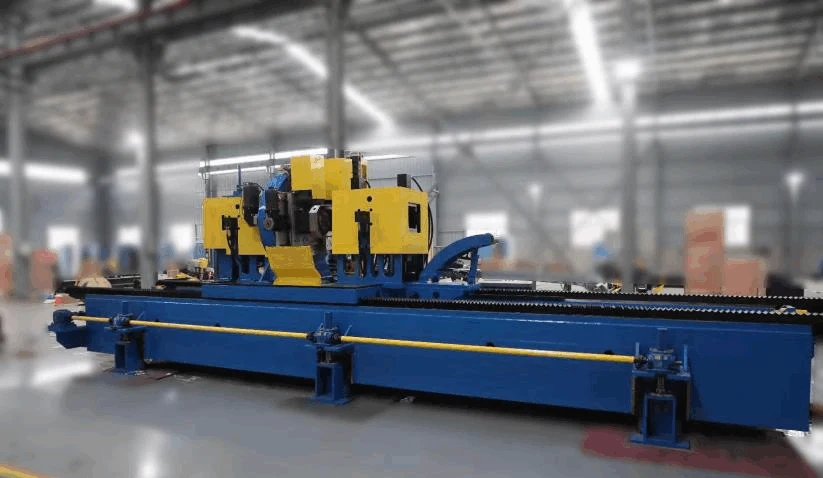
How a Flying Cut-Off Saw Synchronizes with High-Speed ERW Tube Mills (PLC, Servo & Accuracy)
Quick Answer: A flying cut-off saw cuts continuously moving welded steel pipes to exact customer lengths (typically 4–12 m) without ever slowing down or stopping the ERW tube mill. Using a high-resolution measuring wheel encoder at the sizing exit and a SIEMENS or YASKAWA servo motion controller, the saw carriage accelerates to match exact pipe speed (V_saw = V_pipe), clamps the pipe, completes a burr-free cold cut, and reverses home—delivering ±0.5 to ±1.5 mm length accuracy at mill speeds up to 120 m/min.
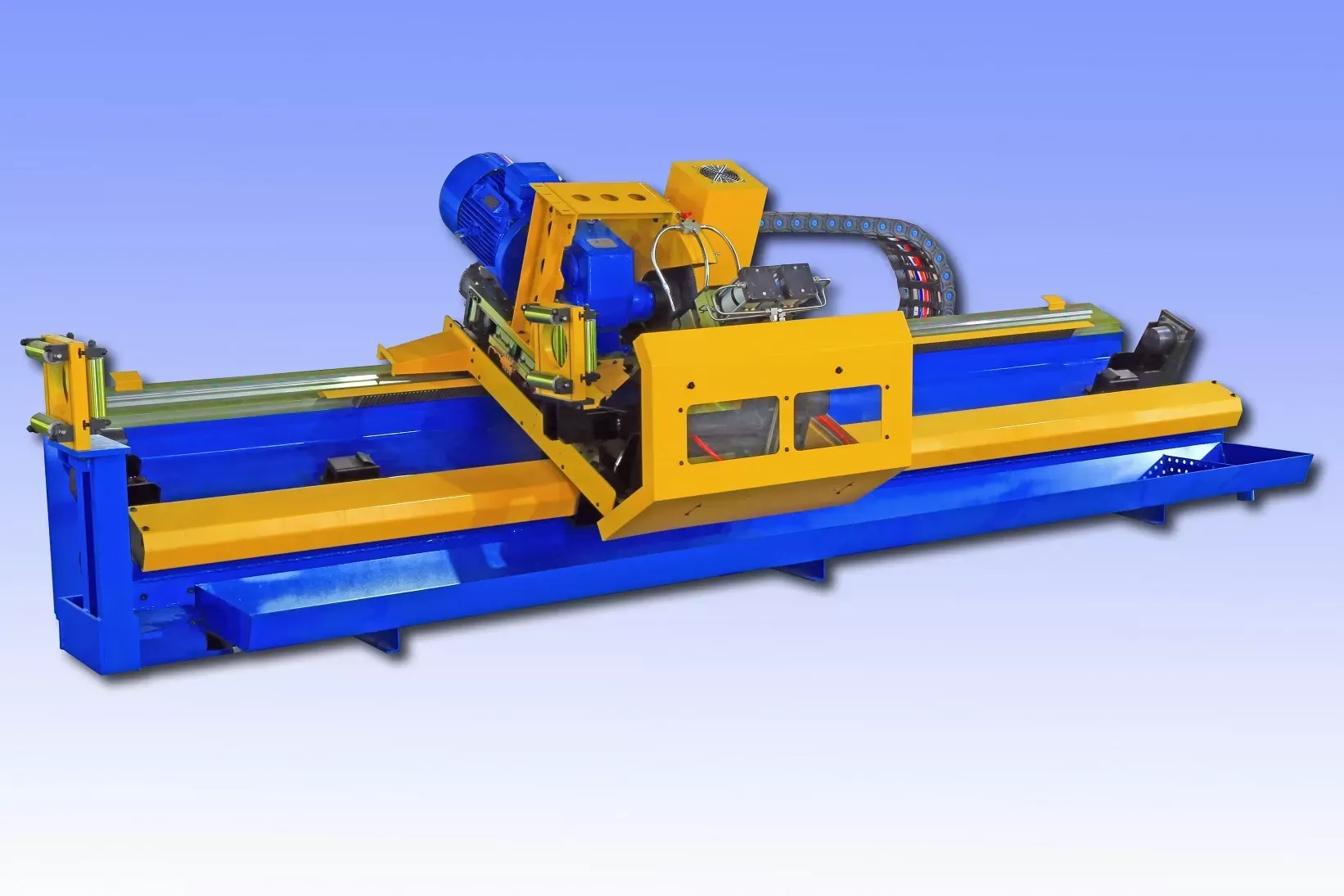
The Engineering Challenge of Cutting Moving Steel Pipe
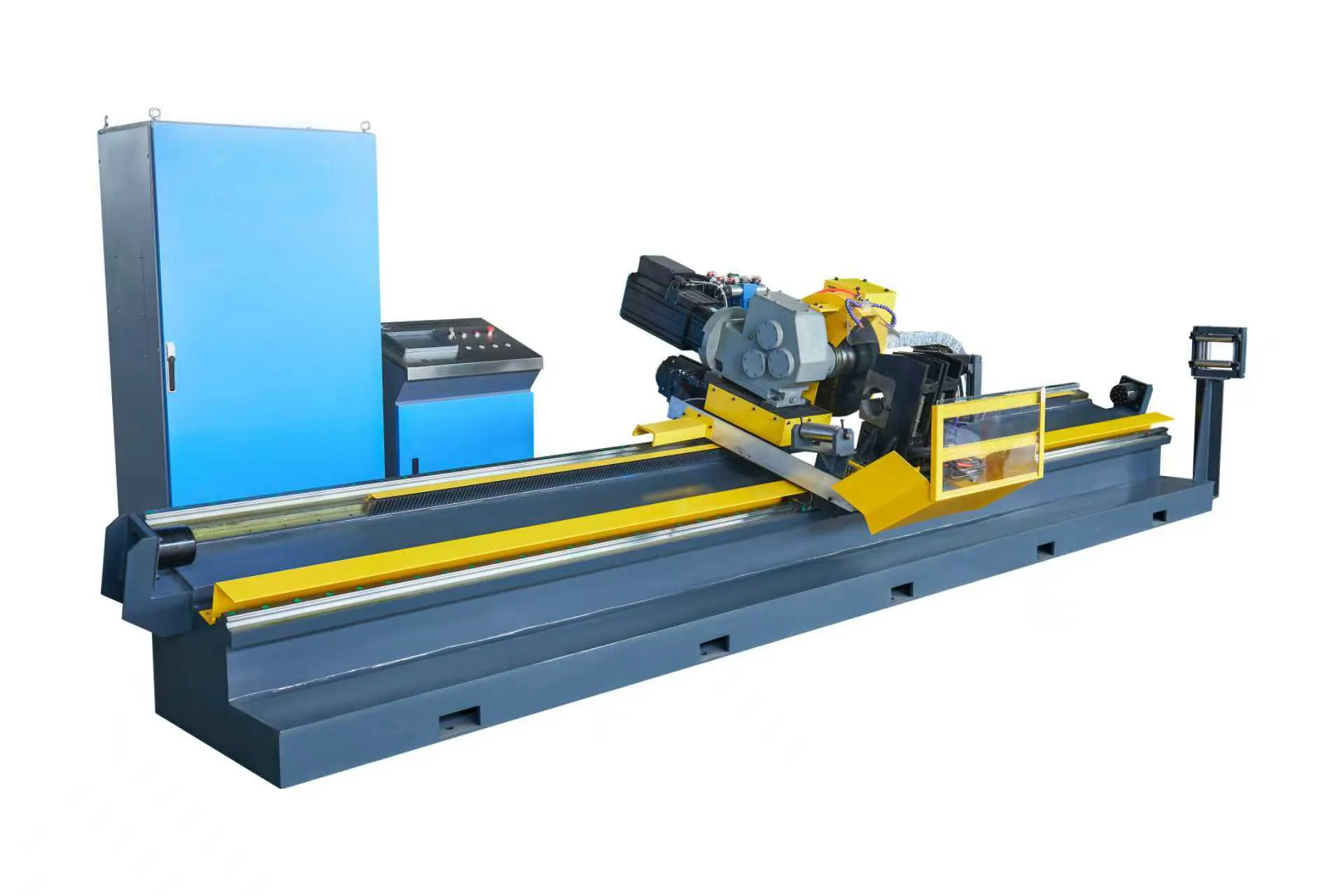
On a modern ERW tube mill, steel pipe exits the final Turk's Head straightening unit continuously at 40 to 120 meters per minute. Stopping the line to cut each 6-meter length would collapse productivity and ruin the high-frequency weld seam inside the welding box.
A flying cold saw solves this by matching the moving pipe's velocity vector in real time. Even a 1.5% velocity mismatch during the 0.8-second blade cut exerts massive axial bending force on the thin circular saw blade—instantly snapping teeth, skewing cut squareness, or jamming the hydraulic clamp jaws.
Inside the 4-Phase Servo Synchronization Cycle
Modern CNC flying cut-off saws replace legacy mechanical cam drives and DC motors with closed-loop AC servo rack-and-pinion carriages. Every single cut executes four deterministic motion phases controlled at a 1–2 millisecond PLC scan rate:
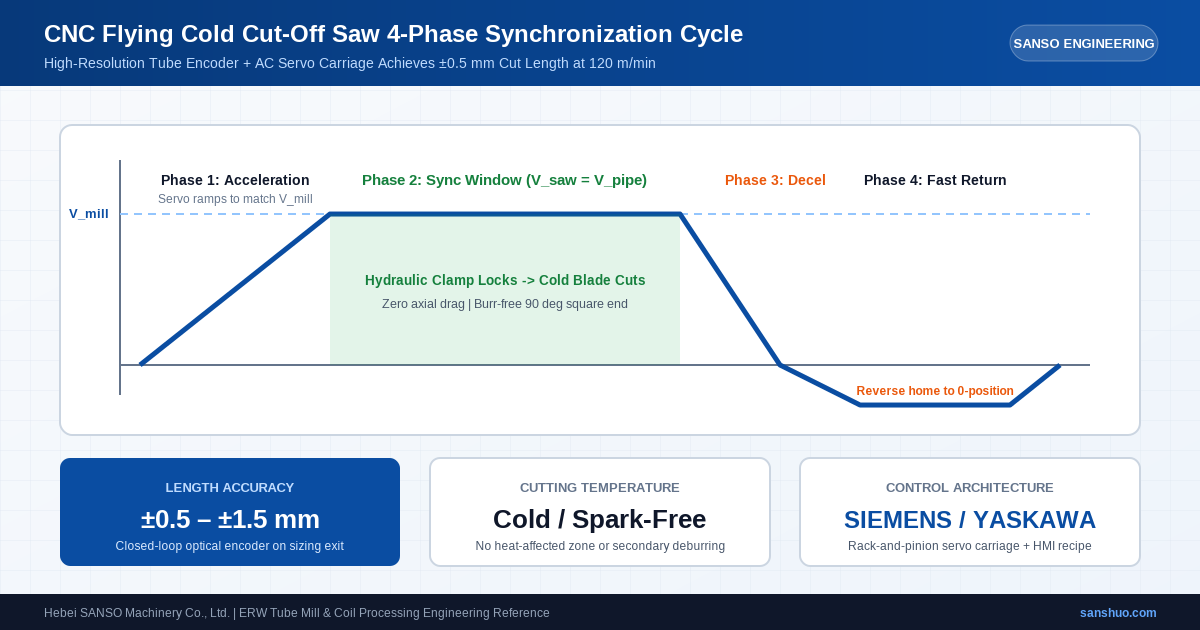
- Phase 1 — Measuring & Trigger Acceleration: A hardened dual-bearing measuring wheel rides cleanly on the exiting pipe and sends 2,500–5,000 pulses/revolution to the motion PLC. When remaining cut length equals the pre-calculated acceleration distance, the servo carriage launches forward along precision linear guideways.
- Phase 2 — Velocity-Locked Sync Window (
V_saw = V_pipe): Once carriage velocity matches pipe velocity within ±0.2%, dual pneumatic/hydraulic vertical and horizontal vise jaws clamp the pipe firmly on both sides of the blade kerf. The CNC milling head (or servo ball-screw feed) plunges the HSS or TCT blade smoothly through the pipe wall. - Phase 3 — Unclamp & Deceleration: Milliseconds after the blade clears the bottom wall thickness, the vise opens and the saw head retracts while the carriage decelerates cleanly before the end-of-bed hydraulic shock absorbers.
- Phase 4 — High-Speed Return to Home: The carriage reverses at up to 1.8× mill speed back to its zero-reference proximity switch, ready to intercept the next length trigger.
Single-Blade Cold Saw vs. Double-Blade Orbit Saw vs. Friction Saw
Selecting the right flying saw architecture depends on pipe outer diameter, wall thickness, and whether end-customers require weld-ready square ends without secondary facing:
| Parameter | CNC Flying Cold Saw (Single Blade) | Orbit Double-Blade Milling Saw | Legacy Flying Friction Saw |
|---|---|---|---|
| Cutting Mechanism | Low-RPM shearing with HSS / TCT blade | Planetary twin TCT blades orbiting pipe | High-RPM friction melting (3,000+ RPM) |
| Optimal Pipe Range | Ø16 – Ø165 mm (0.6 – 6.0 mm wall) | Ø114 – Ø426 mm (4.0 – 16.0 mm wall) | Low-end structural pipe only |
| Cut-End Quality | Mirror-smooth, burr-free, cold touch | Square heavy-wall cut, zero ovality | Heavy molten slag burr & blue HAZ |
| Length Tolerance | ±0.5 – ±1.5 mm | ±1.0 – ±2.0 mm | ±3.0 – ±6.0 mm |
| Noise & Sparks | Quiet (<82 dB), spark-free | Quiet (<85 dB), spark-free | Extreme (>105 dB), heavy sparks & fumes |
| Secondary Deburring | Not required (direct to packing) | Not required (ready for hydrotest/bevel) | Mandatory end-facing labor required |
5 Engineering Keys to Holding ±0.5 mm Cut Length Accuracy
How Top ERW Plants Keep Cut-Length Drift Under 1 mm
- Anti-Slip Encoder Wheel Pressure: Use a spring-loaded knurled or hardened polyurethane-free steel wheel with dual bearings—never let coolant oil film cause wheel hydroplaning on galvanized tubes.
- Zero-Backlash Helical Rack & Pinion: Specify ground DIN 6 helical racks with pre-loaded planetary gearboxes; worn spur gears create 2–4 mm hysteresis during carriage reversal.
- Match Blade Feed Path to Profile Shape: For square/rectangular tubes, program a 45° diagonal plunge or dual-axis orbital cut so the blade never hits the wide flat wall head-on at full width.
- Verify Minimum Cut Length Physics: Short 3-meter cuts at 100 m/min require a carriage cycle time under 1.8 seconds—confirm bed length (typically 4.5–6.5 m) provides adequate accel/decel travel.
- Rigid Dual-Side Clamping Vises: Clamping on both entry and exit sides of the kerf prevents the cut pipe from pinching the blade on exit—the #1 cause of sudden TCT carbide tooth fracture.
Heavy-Wall Pipes (>8 mm) Need Orbit Double-Blade Milling
When cutting large-diameter pipes such as ERW219 or ERW426 with 8–16 mm walls, a single vertical blade requires an oversized 900 mm+ saw disc that flexes easily. SANSO's milling-type orbit double-blade flying cut-off saw uses two compact, rigid carbide blades rotating around the pipe circumference—halving blade cost and eliminating wall-collapse ovality.
Kinematics & Bed-Length Sizing Calculation for High-Speed Flying Saws
Every CNC flying cut-off saw operates inside a strict kinematic budget governed by mill velocity (V_mill), servo carriage acceleration (a_max), clamp + blade cut duration (t_cut), and usable linear rail travel (L_bed). If an ERW plant buys a saw with an undersized 3.5-meter bed for a 100 m/min mill, the carriage physically runs out of track before the blade finishes cutting—forcing operators to throttle the entire tube mill down by 30%.
Worked Kinematic Sizing Example: ERW76 Mill at 100 m/min (6 m Cut Length)
- Given Parameters: Mill speed
V = 100 m/min = 1.667 m/s; servo carriage accelerationa = 4.5 m/s²; hydraulic clamp + cold blade cut + unclamp timet_cut = 0.85 s; return speedV_ret = 2.5 m/s. - Step 1 — Acceleration Distance:
S_acc = V² / (2 × a) = 1.667² / 9.0 = 0.31 m(takes0.37 s). - Step 2 — Constant-Speed Sync Cutting Travel:
S_sync = V × t_cut = 1.667 × 0.85 = 1.42 m. - Step 3 — Deceleration Distance:
S_dec = 0.31 m(takes0.37 s). - Total Forward Stroke Required:
S_total = 0.31 + 1.42 + 0.31 = 2.04 m. Adding 0.6 m safety buffer + carriage base length (1.5 m) specifies a minimum 4.5–5.0 meter CNC flying saw bed. - Step 4 — Minimum Cut Length Check: Total forward + return cycle time is
0.37 + 0.85 + 0.37 + 1.19 = 2.78 s. At1.667 m/s, minimum possible cut length at full speed is2.78 × 1.667 = 4.63 m—meaning standard 6-meter pipes cut effortlessly with 23% cycle-time margin!
Troubleshooting Flying Cut-Off Saw Accuracy & Blade Breakage
When cut lengths drift outside ASTM A53 / EN 10219 limits or saw blades fracture prematurely, diagnose systematically with this field matrix:
| Shop-Floor Symptom | Root Mechanical / PLC Cause | Diagnostic Check | Corrective Fix |
|---|---|---|---|
| Every cut consistently +4 mm too long | Worn measuring wheel OD or incorrect encoder calibration factor | Measure wheel diameter with micrometer vs. HMI pulse/mm value | Re-enter true wheel circumference in HMI or replace worn measuring wheel |
| Random ±8 mm length scatter | Wheel slipping on oily/galvanized pipe or unshielded encoder EMI | Monitor encoder pulse trend graph during mill acceleration | Increase wheel spring pressure, wipe oil ahead of wheel, ground shielded cable at PLC end only |
| Blade pinches & snaps teeth on exit | Velocity lag during cut or single-side clamping letting pipe drop | Log V_saw − V_pipe following error in SIEMENS/YASKAWA servo trace | Tune servo velocity feed-forward gain (≥95%) and verify dual-side vise jaw alignment |
| Out-of-square cut (>1.0 mm angle) | Worn linear guide blocks or blade flange runout >0.04 mm | Check blade face wobble with magnetic-base dial indicator | Clean flange seats, verify blade tensioning, replace pre-loaded linear carriage blocks |
| Heavy internal burr on square tube | Vertical plunge hitting wide flat horizontal wall head-on | Check HMI cutting mode selection (Round vs. Square diagonal) | Switch to 45° diagonal entry or high-speed dual-axis milling trajectory |
HMI Recipe Integration & Automatic End-Weld Crop-Out
Modern SANSO CNC flying cold saws do far more than measure fixed lengths. By linking the flying saw PLC via Profinet/EtherCAT directly to the upstream shear and end welder and inline eddy current NDT tester, the saw tracks every coil butt-weld and detected pinhole seam automatically down the mill length. The moment a defective segment reaches the saw blade, the CNC automatically inserts an off-length crop cut and signals the run-out conveyor diverter to kick that single pipe into the reject rack—delivering 100% defect-free bundles to your packing station.
ROI Comparison: Replacing a Friction Saw with a CNC Flying Cold Saw
For a mid-size ERW76 plant producing 1,500 tons/month of furniture, scaffolding, or automotive tubing, replacing a noisy friction saw with a SANSO CNC flying cold saw eliminates 4–6 full-time manual end-deburring/facing workers, saves ~12 mm of kerf + end-trim steel waste on every 6-meter pipe (~2.5 tons of steel saved/month), slashes shop floor noise from 108 dB down to 79 dB (meeting OSHA occupational noise thresholds), and pays back the complete capital investment in 8 to 12 months.
- ASTM International — A53/A53M & A500 Welded Steel Pipe Length & End Squareness Tolerances.
- API (American Petroleum Institute) — API 5L Line Pipe Cut-End & Dimensional Specifications.
- U.S. OSHA — Occupational Noise Exposure Standards (Cold Sawing vs. Friction Sawing).
- The Fabricator (FMA) — High-Speed Tube Mill Cut-Off & Servo Synchronization Engineering.
- SANSO Machinery: CNC Flying Cold Saw & Orbit Double-Blade Milling Saw.
Frequently Asked Questions (FAQs)
Why does my flying cut-off saw produce random length variations of 5–10 mm?
The three most common culprits are measuring wheel slippage on oily/galvanized pipe, electrical noise on an unshielded encoder cable, or mechanical backlash in a worn pinion gearbox. Inspect encoder wheel spring tension and shielded grounding first.
Can a flying cold saw cut both round and square/rectangular tubes?
Yes. SANSO CNC flying cold saws store separate cutting trajectories in the HMI for round, square, rectangular, and oval tubes, automatically adjusting plunge speed and clamp jaw stroke for each profile.
What is the maximum ERW mill speed supported by a CNC flying cold saw?
Standard SANSO single-blade CNC flying cold saws synchronize cleanly up to 100–120 m/min on 6-meter cut lengths (using SIEMENS SIMOTION or YASKAWA servo drives), while heavy-wall orbit saws run up to 40–60 m/min.
How long does a circular blade last on a flying cold saw?
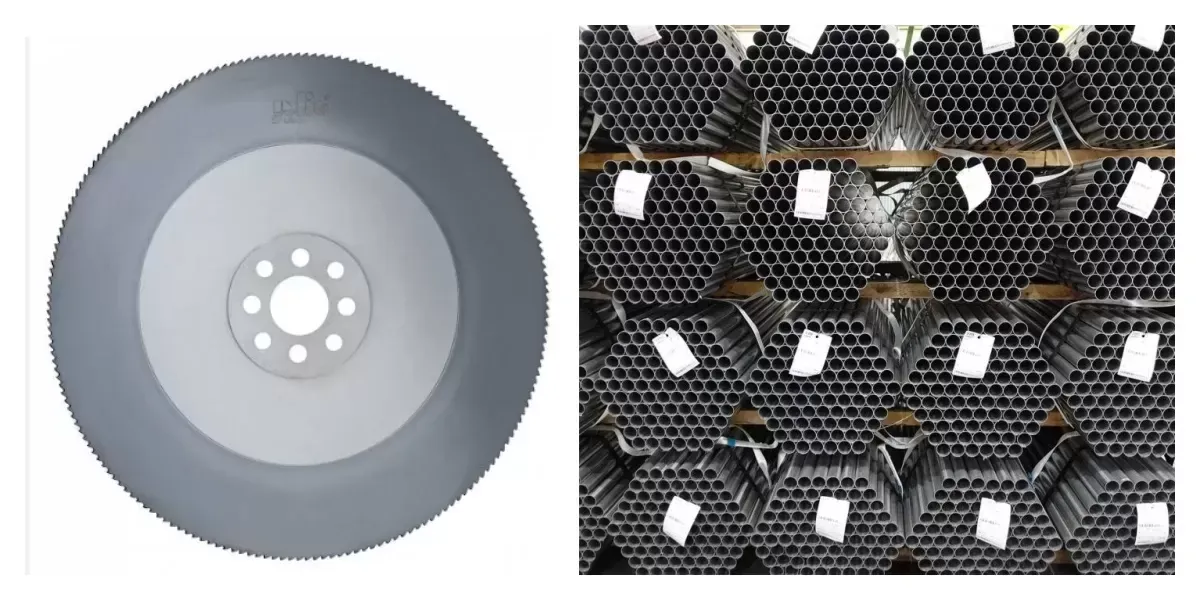
An M35 HSS blade delivers 800–2,000 cuts per sharpening (and can be reground 15–25 times), while a properly cooled TCT carbide blade on a rigid CNC carriage delivers 8,000–20,000 burr-free cuts on mild carbon steel pipe.
Do I need flood emulsion or minimum-quantity mist lubrication (MQL) on a flying cold saw?
HSS cold saws perform best with generous water-soluble emulsion flood coolant (8%–10% concentration) to flush chips and prevent tooth bluing, whereas high-speed TCT flying cold saws perform best with precision MQL oil-mist spray to avoid thermal shock cracking on carbide tips.
Can SANSO retrofit a new CNC flying cold saw onto an existing ERW tube mill?
Yes. Because the flying saw tracks pipe speed independently via its own measuring wheel encoder, SANSO can retrofit a turnkey CNC cold saw onto virtually any existing third-party ERW tube mill during a single weekend shutdown.
How often should the helical rack, pinion, and linear guideways on a flying cut-off saw be lubricated?
SANSO CNC flying cold saws include an automatic progressive central grease lubrication pump timed by cut cycles (typically dispensing EP-2 grease every 300–500 cuts). Operators only need to refill the central reservoir weekly and wipe metallic chips off linear rail wipers each shift.
Can the flying cold saw cut short 1.5–2.0 meter lengths automatically?
Yes. By reducing mill line speed proportionally (or specifying a high-acceleration dual-servo carriage), SANSO CNC flying cold saws cut precision short lengths down to 1.0–1.5 meters cleanly for automotive, shock-absorber, and solar torque-tube applications.
Reviewed by Liu Lei — Chief Technical Advisor (25 Years Experience)
Verified by Chief Technical Advisor Liu Lei and Hebei SANSO's 25-engineer R&D team (founded in 2001) using German COPRA RF roll pass simulation and 300+ global steel pipe mill commissioning records.