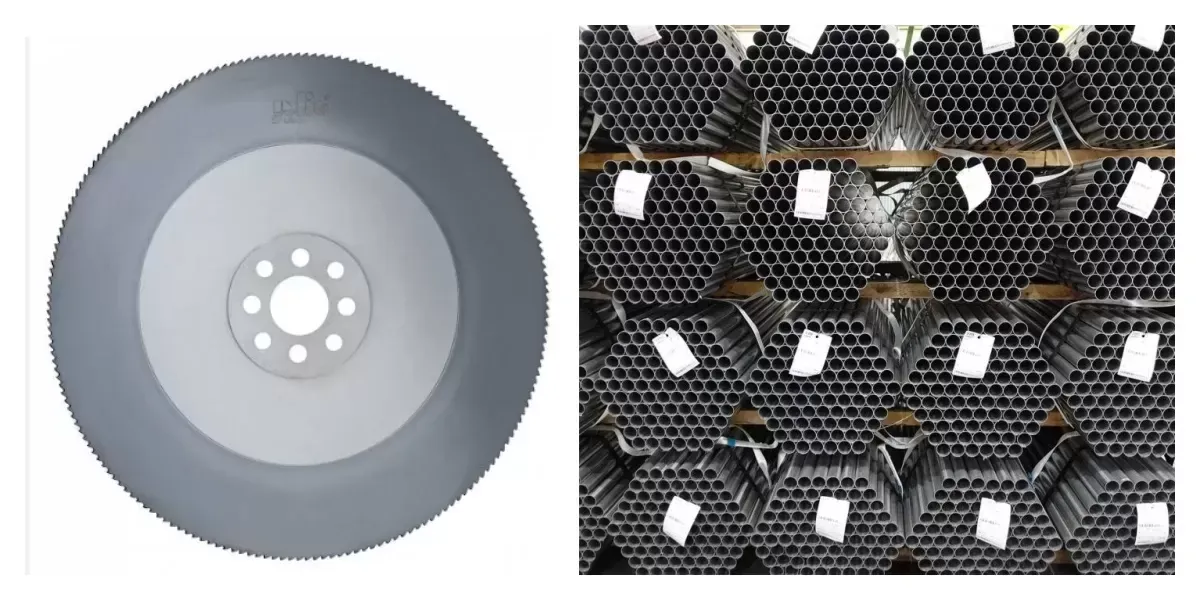
HSS Circular Saw Blades for Metal Cutting: M2 vs. M35 vs. M42 Grades, Coatings & Tooth Pitch
Quick Answer: Selecting the right HSS circular saw blade for metal cutting requires matching three engineering variables to your pipe alloy and wall thickness: steel grade (M2 for mild carbon steel, M35 with 5% Cobalt for Q355/alloy tubes, M42 with 8% Cobalt for stainless 304/316), PVD surface coating (VAPO steam oxide, TiN, TiCN, or TiAlN), and tooth geometry & pitch (BW alternating bevel for walls ≤ 3 mm, HZ triple-chip for walls > 3 mm, keeping 2–4 teeth engaged in the cut).

Understanding HSS Saw Blade Metallurgy: M2 vs. M35 vs. M42
Not every HSS cutting disc or HSS round saw blade is made from the same alloy. The difference between a blade that dulls after 300 cuts and one that delivers 2,000 crisp cuts on an ERW flying cold saw comes down to red-hardness—the steel's ability to retain cutting edge hardness at 550°C–650°C tip temperatures.
HSS-DMo5 (M2 / 1.3343)
Hardness: 63–65 HRC.
Alloy: 6% Tungsten, 5% Molybdenum, 2% Vanadium.
Best For: General-purpose Q195/Q235/A53 carbon steel pipes and light structural profiles (< 600 N/mm² tensile).
HSS-Co5 (M35 / 1.3243)
Hardness: 65–66 HRC.
Alloy: M2 base + 5% Cobalt.
Best For: High-speed ERW mills, Q355B/API 5L structural pipes, and stainless steel 201/304 tubing (600–900 N/mm²).
HSS-Co8 (M42 / 1.3247)
Hardness: 67–68 HRC.
Alloy: 8% Cobalt + elevated Molybdenum.
Best For: Tough 316L austenitic stainless steel, heat-exchanger alloy tubes, and continuous heavy-wall cutting (> 900 N/mm²).
Tooth Forms (BW vs. HZ) & PVD Surface Coatings Explained
On a SANSO HSS circular saw blade, tooth geometry controls chip evacuation while PVD coating slashes friction and prevents cold-welded built-up edge (BUE) on the tooth rake face.
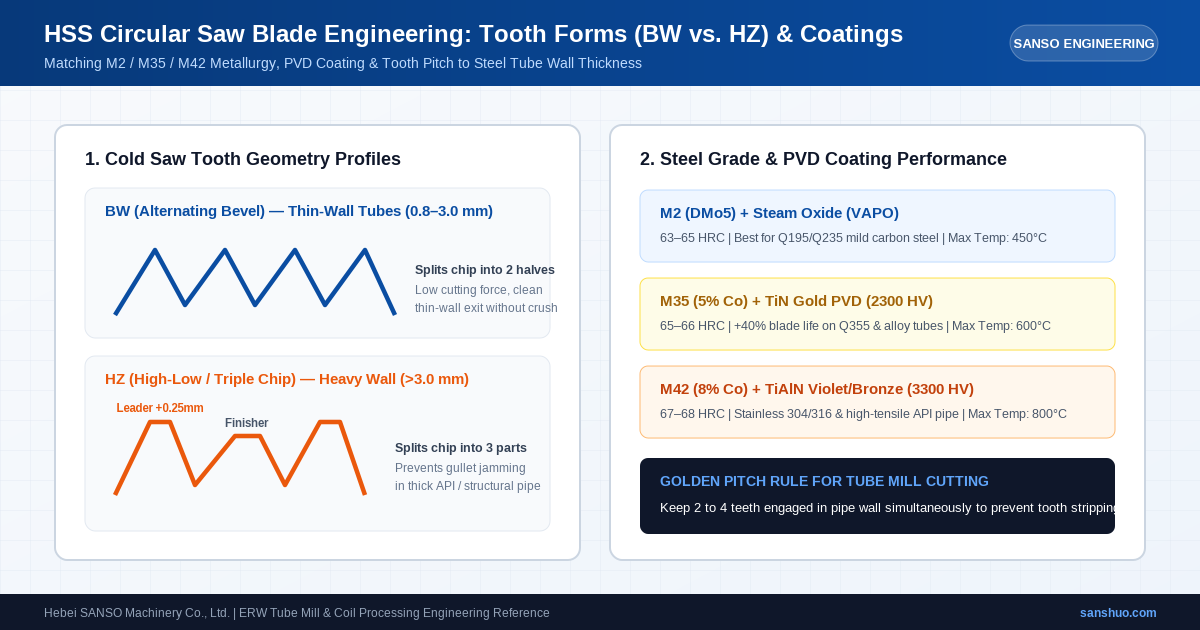
PVD Coating Selection Matrix for HSS Cold Saw Blades
| Coating Type | Color | Surface Hardness | Friction Coeff. | Max Operating Temp | Best Metal Application |
|---|---|---|---|---|---|
| VAPO (Steam Oxide) | Matte Black | ~900 HV | 0.65 (oil-retaining) | 450°C | Mild carbon steel with flood coolant; prevents chip sticking |
| TiN (Titanium Nitride) | Gold | 2,300 HV | 0.40 | 600°C | Universal ERW carbon & galvanized pipe; +40% blade life |
| TiCN (Ti Carbonitride) | Blue-Gray | 3,000 HV | 0.25 | 450°C | Abrasive stainless & high-tensile steel at moderate speeds |
| TiAlN (Ti Aluminum Nitride) | Dark Bronze/Violet | 3,300 HV | 0.35 | 800°C | High-speed flying cold saws & dry/MQL alloy tube cutting |
Tooth Pitch & Cutting Speed Reference Table (Steel Pipe & Tube)
The single most common mistake in tube mills is using a coarse pitch blade on thin-wall pipe (which strips teeth instantly as the wall hooks into the gullet) or an overly fine pitch on thick wall (which packs chips tightly and stalls the saw motor). Apply the 2-to-4-Tooth Engagement Rule:
| Tube Wall Thickness | Recommended Tooth Pitch (T) | Tooth Count (Ø350 mm Blade) | Tooth Form | Cutting Speed (Carbon Steel) |
|---|---|---|---|---|
| 0.6 – 1.2 mm | T3 – T4 mm | 260 – 320 Z | BW | 70 – 90 m/min |
| 1.2 – 2.5 mm | T4 – T6 mm | 180 – 260 Z | BW | 60 – 80 m/min |
| 2.5 – 4.0 mm | T6 – T8 mm | 140 – 180 Z | BW / HZ | 50 – 70 m/min |
| 4.0 – 8.0 mm | T8 – T11 mm | 100 – 140 Z | HZ (Triple-Chip) | 40 – 55 m/min |
Maximize ROI with In-House CNC HSS Blade Re-Sharpening
Unlike disposable carbide discs, a quality M2 or M35 HSS cold saw blade can be precision reground 15 to 25 times before its outer diameter becomes too small. Investing in a CNC HSS saw blade sharpening machine with a CBN grinding wheel restores factory BW/HZ tooth geometry in 8 minutes per blade and slashes annual blade spending by 65%.
Never Run HSS Blades Until Teeth Turn Blue or Chip
Pull your HSS blade for re-sharpening as soon as cut burr height increases slightly or motor amperage rises 15% above baseline. Running a dull blade for "just one more hour" overheats the rim, causes micro-cracks down the gullet, and requires grinding off 3× more steel diameter during reconditioning.
Worked Cutting Parameters: Calculating Exact RPM, Feed Rate & Chip Load
Even a premium cobalt M35 TiAlN HSS circular saw blade will fail in minutes if spun at the wrong RPM or plunged at an excessive feed rate. According to high-speed tool steel machining standards (DIN 1837/1838 and ISO 4957), every alloy requires a disciplined balance of surface cutting velocity (V_c) and feed per tooth (f_z).
Step-by-Step Worked Calculation: Cutting Ø60 × 2.5 mm Q235B ERW Tube
- Step 1 — Select Blade Spec: Ø350 mm × 2.5 mm kerf, M35 (5% Co) + TiN Gold,
Z = 220 teeth(Pitch T5, BW tooth form — keeps ~3 teeth engaged across the 2.5 mm wall). - Step 2 — Calculate Exact Spindle RPM: Target
V_c = 65 m/minfor M35 TiN on Q235B carbon steel.RPM = (V_c × 1000) / (π × D) = (65 × 1000) / (3.1416 × 350) = 59.1 RPM(set saw inverter to 58–60 RPM). - Step 3 — Calculate Plunge Feed Rate (
V_f): Optimal chip load for HSS on carbon steel tube isf_z = 0.03–0.05 mm/tooth. Using0.04 mm/tooth:V_f = RPM × Z × f_z = 59 × 220 × 0.04 = 519 mm/min (8.65 mm/sec). - Step 4 — Verify Total Cut Duration: Plunging across Ø60 mm + 10 mm air clearance (70 mm stroke) takes
70 / 8.65 = 8.1 son a stationary cold saw, or using high-speed flying-saw 120 RPM orbital-plunge parameters drops cut duration under 1.8 seconds cleanly with cool silver chips.
Blade Failure Diagnosis: Reading Chips & Tooth Wear Patterns
Experienced saw engineers inspect ejected chips before touching any machine setting. Chip color and curl immediately reveal whether your HSS cold saw blade is operating in its ideal mechanical sweet spot:
| Chip / Blade Symptom | Root Metallurgical / Machine Cause | Immediate Parameter Adjustment |
|---|---|---|
| Dark blue or purple chips + smoking | Cutting speed (RPM) too high or diluted/insufficient flood coolant | Drop blade RPM by 20%; raise emulsion concentration to 8%–10% and aim twin nozzles directly into the kerf |
| Powdery metallic dust instead of curled chips | Feed rate too slow (teeth rubbing instead of shearing) or dull cutting edges | Increase plunge feed rate 15%–25% or pull blade immediately for CNC re-sharpening |
| Stripped / broken cluster of 3–5 teeth | Tooth pitch too coarse for thin wall (<2 teeth engaged) or pipe shifted in vise | Switch to finer pitch (T3–T4) and verify hydraulic clamping vise holds pipe rigid on both sides |
| Built-Up Edge (welded steel lumps on tips) | Low-lubricity coolant on gummy mild steel or uncoated bright blade | Switch to VAPO steam-oxide or TiN-coated M35 blade with extreme-pressure (EP) semi-synthetic emulsion |
| Blade wanders / crooked cut | Uneven side-clearance grinding, worn blade stabilizing pads, or loose flange | Inspect blade lateral runout (≤0.05 mm) and re-level guide pads on CNC sharpening check |
Proper Break-In Procedure & Re-Sharpening Economics
Never run a brand-new or freshly reground HSS circular saw blade at 100% feed rate on Cut #1. Freshly ground micro-edges carry microscopic grinding burrs that snap easily under full shock load. Running the first 15 to 20 cuts at 60%–70% feed rate micro-hones the cutting edge smoothly and extends total blade life by 25%–35%.
On the financial side, pairing SANSO M35 HSS blades with an in-house CNC HSS saw blade sharpening machine transforms blade cost: a single $95 Ø350 mm M35 blade reground 20 times delivers ~30,000 total burr-free cuts—bringing effective tooling cost down to less than $0.005 per cut.
Complete Handling, Storage & Flange Mounting Checklist
- Clean Flange Faces Every Swap: A single 0.1 mm steel chip trapped between the saw arbor flange and blade body creates 0.5 mm lateral rim wobble, ruining cut squareness and cracking the hub.
- Take Up Drive-Pin Backlash: Before tightening the central arbor nut, always rotate the blade slightly opposite to cutting rotation so the drive pins seat firmly against the pinholes—preventing shock-shearing on startup.
- Match Flange Diameter: Always use heavy flanges equal to at least 1/3 of the blade outer diameter (e.g., Ø115–125 mm flanges for a Ø350 mm blade) to maximize lateral cutting stiffness.
- DIN German Institute for Standardization — DIN 1837 & DIN 1838 High-Speed Steel Circular Saw Blade Geometry.
- ISO — ISO 4957 Tool Steels Classification (M2 / M35 / M42 Cobalt High-Speed Steels).
- Wikipedia Metallurgy Reference — High-Speed Steel (HSS) Composition, Red Hardness & PVD Coatings.
- ASM International — Tool Steels & Cold Metal Sawing Tribology Handbook.
- SANSO Cutting Tooling: HSS & TCT Circular Saw Blades & CNC HSS Saw Blade Sharpening Machine.
Frequently Asked Questions (FAQs)
Should I buy M2 or M35 HSS circular saw blades for an ERW carbon steel tube mill?
For low-carbon Q195/Q235 furniture or fence tubes at moderate speeds, M2 + VAPO or TiN offers the lowest upfront cost. For high-speed ERW mills (>60 m/min) or Q355/API structural pipes, M35 (5% Cobalt) + TiN/TiAlN delivers 40%–60% longer edge life between sharpenings.
What coolant concentration is best for HSS cold saw blades?
Use a high-lubricity synthetic or semi-synthetic water-soluble emulsion maintained at 8%–10% refractometer concentration (not plain 3% mill water). Richer lubrication prevents chip welding on the tooth flank.
How do I calculate the right RPM for my HSS cutting blade?
Use the formula RPM = (Cutting Speed in m/min × 1000) / (3.1416 × Blade Diameter in mm). For example, a Ø350 mm M35 blade cutting carbon steel at 65 m/min should run at approximately 59 RPM.
Why do my HSS saw blades crack radially from the gullet?
Radial gullet cracks are typically caused by feed rate set too high for wall thickness, insufficient clamping causing pipe vibration, dull teeth generating excessive heat, or sharp V-notches left in the gullet during poor manual sharpening.
What bore and pinhole patterns does SANSO offer on HSS circular blades?
We supply standard 32 mm, 40 mm, and 50 mm bores with universal comb-pin patterns (2/8/45, 2/9/50, 2/11/63, 4/12/64) to fit SANSO, Eisele, Kaltenbach, MTM, and all major Asian and European flying cold saws.
Does PVD coating remain after I sharpen an HSS blade?
Re-sharpening removes the coating from the tooth rake and clearance face, while leaving coating intact on the blade sides (which still cuts side friction). For heavy stainless production, blades can be stripped and PVD re-coated after 3–4 sharpenings.
What is the correct rake angle and clearance angle when re-sharpening HSS cold saw blades?
For standard mild carbon steel ERW tubes (Q195–Q235), grind a 12°–15° positive rake angle and 8°–10° clearance angle. For tougher Q355 structural steel or 304/316 stainless steel, reduce rake angle to 8°–10° to reinforce tooth tip strength against chipping.
How small can an HSS circular saw blade be ground before retiring it?
Typically an HSS blade can be re-sharpened until its diameter drops by 25–35 mm (e.g., a Ø350 mm blade down to ~Ø315 mm), provided it still clears the largest pipe OD in your cutting schedule and retains proper flange clearance.
Reviewed by Liu Lei — Chief Technical Advisor (25 Years Experience)
Verified by Chief Technical Advisor Liu Lei and Hebei SANSO's 25-engineer R&D team (founded in 2001) using German COPRA RF roll pass simulation and 300+ global steel pipe mill commissioning records.