
TCT vs. HSS Circular Saw Blades for Steel Pipe Cutting: Speed, Cost per Cut & Blade Life
Quick Answer: A TCT circular saw blade (Tungsten Carbide Tipped) runs 3× faster than an HSS blade (150–260 m/min vs. 40–90 m/min) and achieves up to 10× more cuts per blade on thick-wall structural and API steel pipes—cutting cost per cut by 35%–50% on high-speed CNC flying cold saws. However, TCT blades are brittle and demand a rigid, zero-backlash CNC saw carriage; for thin-wall (<2.0 mm) tubing, mixed short batches, or older gear-driven saws, an HSS blade remains tougher and more economical.
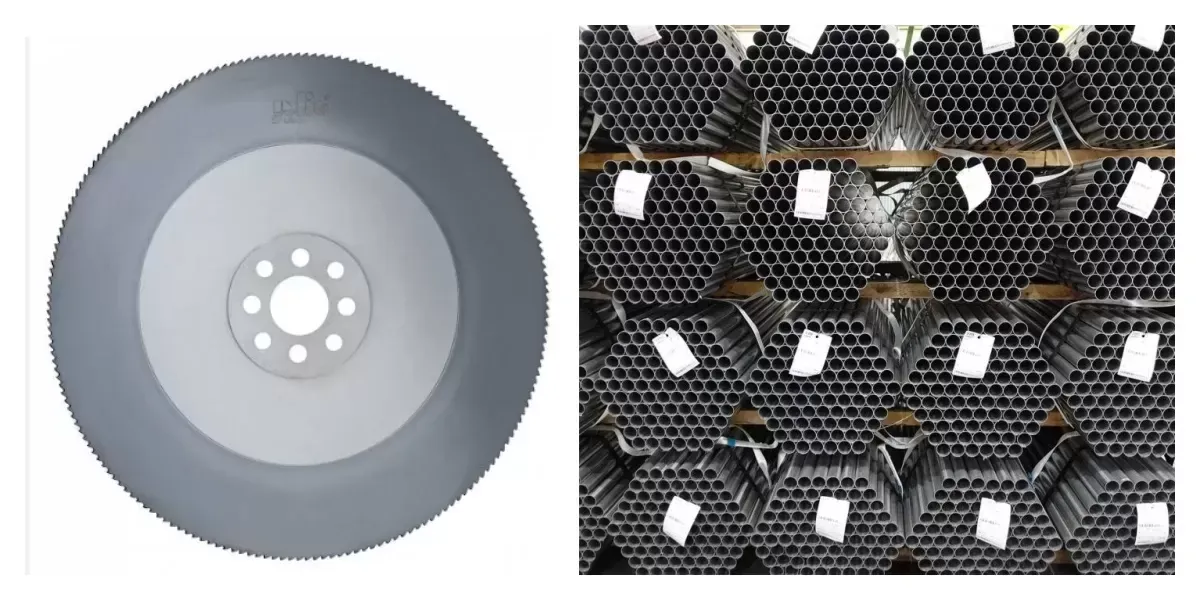
Core Structural Difference: Solid Tool Steel vs. Brazed Carbide Tips
An HSS cold saw blade is machined from a single solid disc of hardened high-speed tool steel (63–68 HRC). In contrast, a TCT blade for metal combines two engineered materials: a laser-cut, tensioned SKS51 / 75Cr1 alloy steel body (42–46 HRC for vibration damping) with ultra-hard micro-grain tungsten carbide or cermet cutting tips (91–93 HRA, ~1,650 HV) brazed onto every tooth seat.
Because tungsten carbide retains its cutting edge up to 1,000°C—nearly double the softening point of HSS—a TCT cutting blade slices through thick-wall carbon and alloy steel pipe at triple the surface speed while transferring virtually all cutting heat into the ejected chips rather than the pipe end.
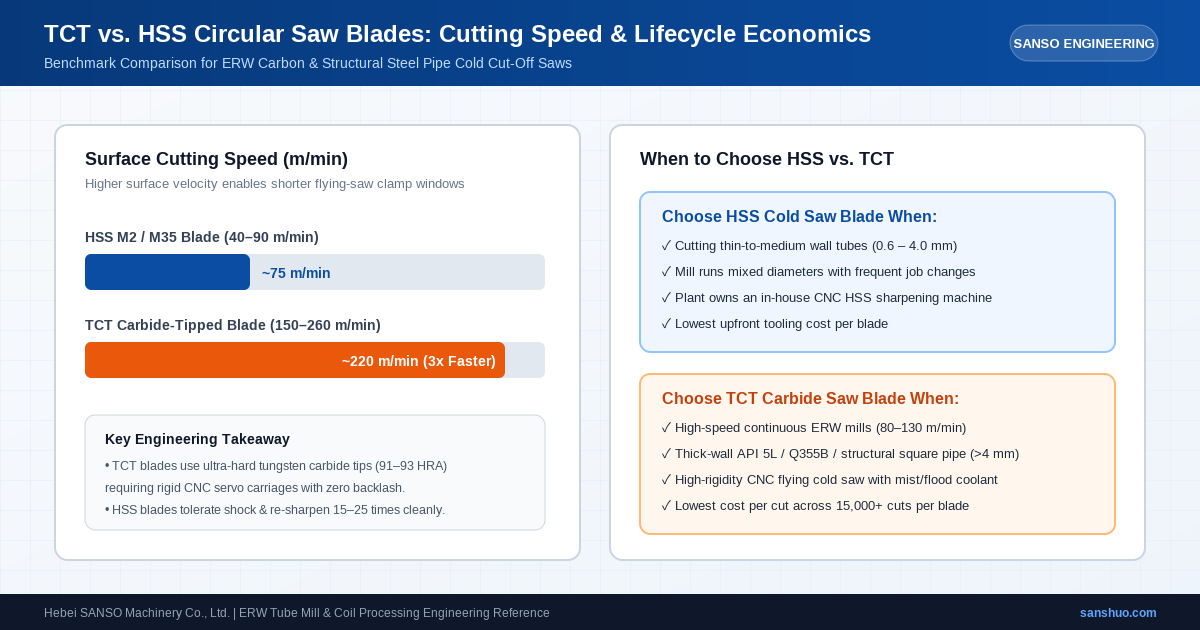
Head-to-Head Engineering Comparison: TCT vs. HSS
| Performance Metric | TCT Circular Saw Blade (Cermet / Carbide) | HSS Circular Saw Blade (M2 / M35) |
|---|---|---|
| Tip Hardness | 91–93 HRA (~1,600–1,800 HV) | 63–66 HRC (~800–880 HV) |
| Surface Cutting Speed | 150 – 260 m/min | 40 – 90 m/min |
| Cut Time (Ø76 × 3.5 mm Pipe) | 0.4 – 0.7 seconds | 1.3 – 2.2 seconds |
| Cuts Before Replacement/Grind | 8,000 – 20,000 cuts (single life / 1–2 regrinds) | 800 – 2,000 cuts (regrindable 15–25 times) |
| Machine Rigidity Requirement | Strict — CNC servo feed, zero spindle play | Forgiving — tolerates light vibration & manual feed |
| Optimal Wall Thickness | 2.0 – 16.0 mm (heavy wall & high-tensile) | 0.6 – 4.0 mm (thin-to-medium wall) |
| Coolant Preference | Dry or MQL oil-mist spray (avoids thermal shock) | Flood water-soluble emulsion (8%–10%) |
| Kerf Width (Ø355 mm) | 2.0 – 2.6 mm (thin-kerf cermet saves steel) | 2.5 – 3.0 mm |
Real-World Cost-per-Cut Analysis on an ERW76 Tube Mill
Many tube mill managers hesitate when they see a TCT circular saw blade costs 1.8× to 2.5× more upfront than a standard HSS blade. However, evaluating total cost per 10,000 cuts (blade cost + sharpening labor + blade-changeover downtime) tells a completely different story on high-output lines:
Scenario A: High-Speed 24/7 ERW76 (3.0 mm Wall)
Winner: TCT Cermet Blade. Runs 14,000 cuts cleanly across 4 continuous shifts without stopping the line for blade swaps—eliminating 8 blade changeovers and lowering total cost per cut by ~38%.
Scenario B: Thin-Wall ERW32 Furniture Tube (1.0 mm)
Winner: M35 HSS TiN Blade. Thin walls flex slightly during clamping, which chips brittle TCT tips; a fine-tooth BW HSS blade runs safely and sharpens 20+ times in-house.
Scenario C: Heavy-Wall ERW219 Structural (8.0 mm)
Winner: TCT Blade on Orbit Milling Saw. HSS blades would overheat and require 6+ second cuts; twin TCT carbide blades finish heavy-wall API/structural cuts in under 2 seconds cold.
Critical Warning: Never Put a TCT Blade on a Loose or Flood-Cooled Legacy Saw
Two mistakes destroy brand-new TCT blades in under 50 cuts: (1) Spindle or linear-rail play—micro-chatter fractures tungsten carbide instantly; and (2) Cold flood water hitting red-hot carbide tips causes thermal-shock micro-spalling. Always run TCT metal blades on a rigid CNC flying cold saw with precision MQL mist lubrication and verify spindle runout is ≤ 0.02 mm.
Cermet vs. Tungsten Carbide TCT Tips: Which Should You Specify?
- Cermet-Tipped TCT (TiC/TiN Ceramic-Metal): Superior chemical stability and low friction against carbon steel—produces a near-mirror surface finish with virtually zero burr at 200+ m/min. Standard choice for mild carbon ERW pipes (Q195–Q355).
- Micro-Grain Tungsten Carbide (WC-Co + TiAlN): Higher transverse rupture toughness than cermet. Recommended for work-hardening stainless steel tubes (304/316), thick-wall API 5L linepipe, and interrupted square-tube cuts.
Total Cost-per-Cut Financial Model: 100,000 Cuts on an ERW89 Pipe Mill
To move beyond rule-of-thumb opinions, let us run an exact plant-floor financial audit comparing a TCT circular saw blade against an M35 HSS blade across 100,000 cuts of Ø76 × 3.2 mm Q235B structural pipe on a two-shift CNC flying cold saw:
| Cost Category (100,000 Cuts) | M35 HSS Blade (Ø350 mm, TiN) | TCT Cermet Blade (Ø355 mm, 2.2 mm Kerf) |
|---|---|---|
| Average Cuts per Life / Grind | 1,400 cuts per sharpening (20 grinds/blade) | 14,000 cuts per blade (disposable thin-kerf) |
| Blades Consumed | 3.6 blades (~$340 blade purchase) | 7.2 blades (~$1,150 blade purchase) |
| Re-Sharpening Cost (71 grinds × $12) | $852 | $0 (no sharpening needed) |
| Blade Changeover Stops (10 min each) | 71 stops = 11.8 hours lost mill uptime | 7 stops = 1.2 hours lost mill uptime |
| Lost Output Value ($180/hr mill margin) | $2,124 opportunity cost | $216 opportunity cost |
| Kerf Steel Scrap Saved (0.6 mm narrower) | Baseline | Saves ~60 m of pipe (~$280 steel saved) |
| Net True Cost per 100,000 Cuts | $3,316 ($0.033 / cut) | $1,086 ($0.011 / cut — 67% Lower TCO!) |
The accounting lesson is unmistakable: when mill uptime and operator labor are counted honestly, a TCT blade for metal slashes true cutting cost by more than half on continuous medium-to-heavy wall ERW lines. Conversely, on a low-utilization job shop running 150 cuts/day with an older gear-head cold saw, an HSS blade avoids brittle carbide breakage and wins decisively.
Machine Rigidity Audit: 6 Checks Before Switching from HSS to TCT
Because tungsten carbide has roughly three times the elastic modulus of tool steel but far lower impact toughness, installing a TCT blade onto a loose saw carriage guarantees instant tip fracture. Complete these six mechanical checks before making the switch:
- Arbor Spindle Axial & Radial Runout: Measure spindle nose with a 0.001 mm dial indicator; both radial and face runout must stay strictly ≤ 0.02 mm.
- Backlash-Free Gearbox & Brake: Verify helical saw-head gear teeth have minimal backlash (ideally an anti-backlash damper brake on the spindle) so interrupted entry into round pipe walls does not hammer carbide tips.
- Servo Ball-Screw Plunge Feed: Pneumatic or uncontrolled hydraulic feed cylinders surge forward as the blade exits the top wall, shattering TCT tips. Positive mechanical servo ball-screw feed is mandatory.
- Rigid Dual-Side Clamping Vises: Both incoming and outgoing sides of the cut pipe must lock firmly so the cut stub never twists against the blade flank.
- MQL Oil-Mist Cooling Setup: Convert flood-water nozzles to an ester-based Minimum Quantity Lubrication (MQL) mist unit (15–30 mL/hr) to eliminate thermal-shock micro-cracking of hot carbide tips.
- Chip-Breaker Wire Brush: Install a rotating brass or nylon chip-removal brush at the rear of the saw guard to knock sticky chips out of tooth gullets before they re-enter the cut.
Recommended TCT Cutting Speed & Chip-Load Matrix
| Pipe Material | Recommended Tip Grade | Surface Speed (V_c) | Chip Load (f_z) | Cooling Method |
|---|---|---|---|---|
| Mild Carbon (Q195 / Q235 / A53) | Cermet (TiC-TiN) | 180 – 250 m/min | 0.05 – 0.08 mm/tooth | Dry or MQL oil mist |
| Structural / API (Q355B / X52) | Micro-grain Carbide + TiAlN | 140 – 190 m/min | 0.04 – 0.07 mm/tooth | MQL oil mist |
| Stainless Steel (304 / 316L) | Sub-micron WC-Co + AlTiN | 90 – 130 m/min | 0.03 – 0.05 mm/tooth | Heavy MQL oil mist |
| Galvanized ERW Tube | Cermet + Low-Friction PVD | 170 – 220 m/min | 0.05 – 0.07 mm/tooth | MQL + chip brush |
- ISO — ISO 513 Classification & Application of Hard Cutting Materials (Carbide & Cermet Grades).
- Wikipedia Metallurgy Reference — Tungsten Carbide & Cermet Properties in Industrial Cutting Tools.
- SME (Society of Manufacturing Engineers) — High-Speed Cold Sawing & Carbide Tool Life Engineering.
- The Fabricator (FMA) — Carbide vs. HSS Cold Saw Blade Selection for Tube Mills.
- SANSO Tooling: TCT Circular Saw Blades, HSS Circular Saw Blades & CNC Flying Cold Saw.
Frequently Asked Questions (FAQs)
Can a TCT circular saw blade be resharpened?
Disposable thin-kerf cermet blades (2.0 mm kerf) are engineered to run 10,000–20,000 cuts and then recycle cleanly without regrind setup costs. Heavy-body tungsten carbide blades (≥2.6 mm kerf) can be reground 2–4 times on a specialized diamond-wheel CNC grinder.
Why did my TCT blade lose three teeth on the first shift?
Early tooth chipping is almost always caused by chip-load exceeding 0.08 mm/tooth, loose vise clamping letting the cut pipe pinch the exit side of the blade, or worn saw-head gearbox backlash.
Can TCT blades cut stainless steel ERW tubes?
Yes, provided you specify a dedicated stainless-grade micro-grain carbide tip with TiAlN coating (not a mild-steel cermet tip) and reduce surface cutting speed to 90–130 m/min with MQL mist cooling.
Why do TCT blades have laser-cut expansion slots filled with resin or copper?
Laser slots relieve thermal expansion stress so the disc stays dead flat at 2,000+ RPM, while resin/copper plugs dampen harmonic ringing noise and prevent resonant chatter during pipe entry.
What chip load (feed per tooth) is optimal for TCT metal cutting?
Target 0.04 to 0.08 mm/tooth on carbon steel pipe. Feeding too slowly (<0.02 mm/tooth) rubs instead of shearing and polishes the carbide edge dull rapidly.
Does SANSO supply both TCT and HSS blades matched to our pipe size?
Yes. Share your pipe OD, wall thickness, steel grade, and saw RPM, and SANSO engineers will specify exact blade diameter, kerf, tooth count, and tip grade from stock.
Why do TCT circular saw blades have a slightly negative or zero rake angle compared to HSS blades?
Tungsten carbide is extremely strong in compression but weaker in tension. A 0° to -5° rake angle (with a reinforced micro-chamfer) places cutting forces squarely into compression along the carbide tip seat, preventing edge chipping when piercing hard weld beads.
Can I switch an existing SANSO flying cold saw from HSS blades to TCT blades?
Yes—provided the saw head has a high-RPM inverter spindle capable of 150–250 m/min surface speed (typically 140–220 RPM on a Ø355 mm blade) and servo ball-screw plunge feed. Contact SANSO engineering to verify your gearbox ratio before upgrading.
Reviewed by Liu Lei — Chief Technical Advisor (25 Years Experience)
Verified by Chief Technical Advisor Liu Lei and Hebei SANSO's 25-engineer R&D team (founded in 2001) using German COPRA RF roll pass simulation and 300+ global steel pipe mill commissioning records.