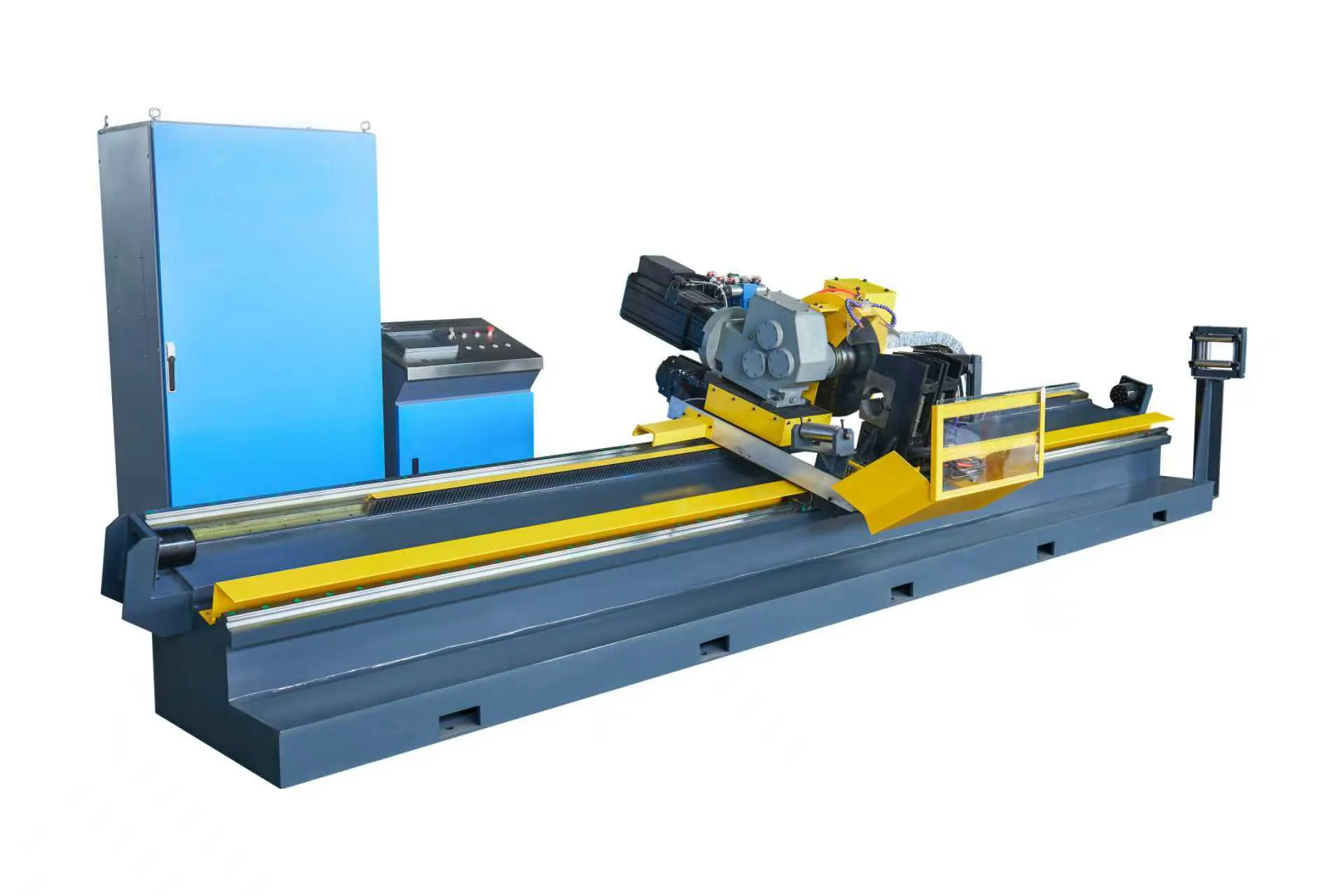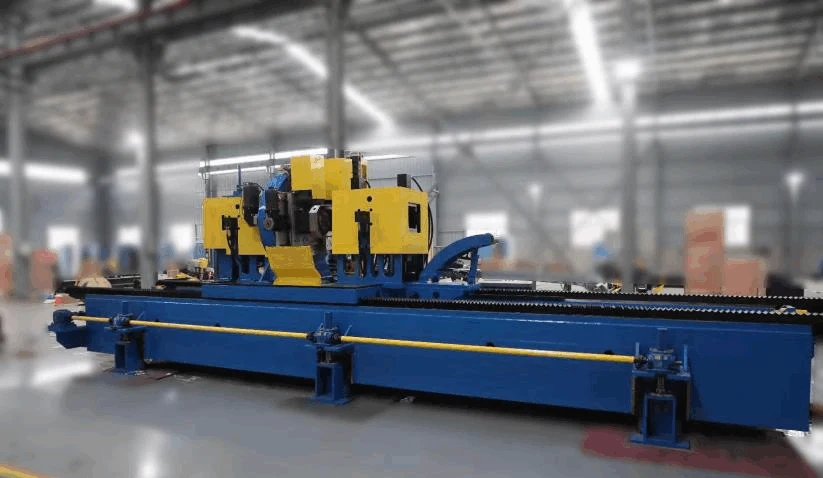
Rotary Shear vs. Flying Shear CTL Machines: Accuracy, Speed & Sheet Flatness Explained
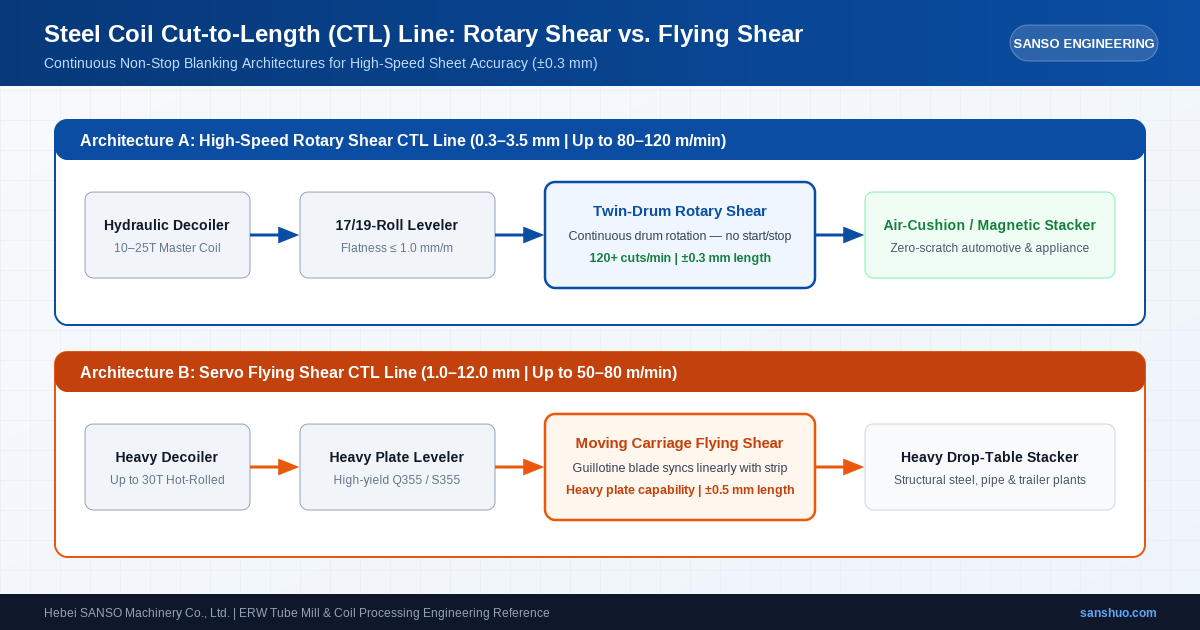
Quick Answer: Choosing the right CTL machine (cut to length machine) depends on strip gauge and throughput targets: a rotary shear CTL line excels on thin-to-medium coils (0.3–3.5 mm) at blazing continuous speeds up to 80–120 m/min with ±0.3 mm accuracy; a servo flying shear CTL line handles heavy hot-rolled and structural plate (1.0–12.0 mm) non-stop at 50–80 m/min; while an economical start-stop roll-feed shear suits lower-volume shops under 35 m/min.
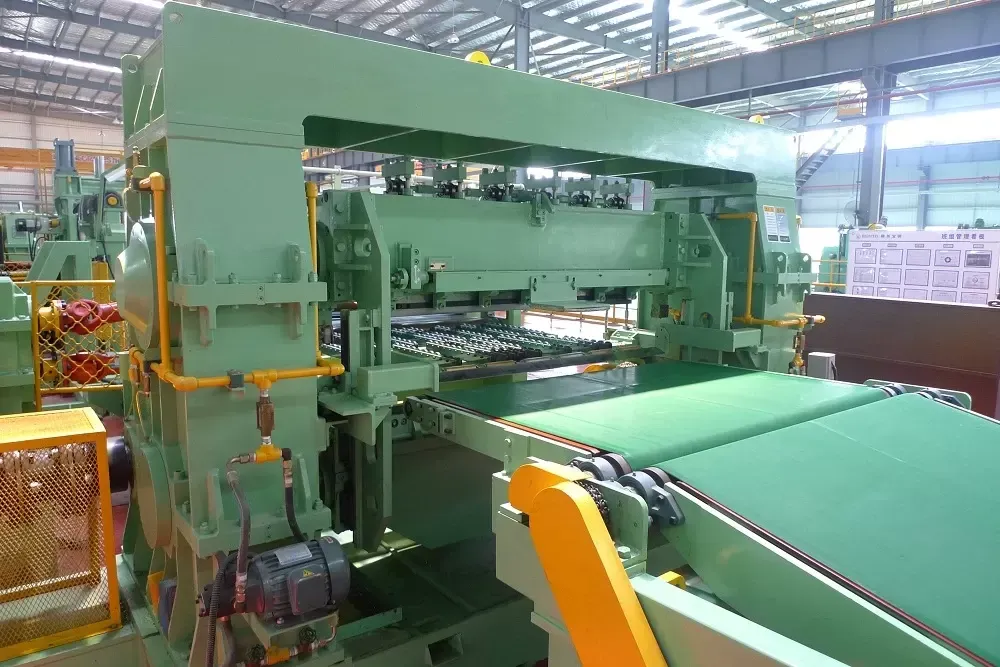
The 3 Core Architectures of Steel Coil Cutting Machines
Every modern cut to length line converts rolled master steel coils into dead-flat, square-cut rectangular sheets for automotive stamping, appliance panels, electrical cabinets, steel structures, and welded pipe plate blanking. What separates an entry-level length cutting machine from a high-output steel service center line is how the shear interacts with the moving strip.
Engineering Comparison: Start-Stop vs. Flying Shear vs. Rotary Shear
| Technical Parameter | Start-Stop Servo Feed CTL | Servo Flying Shear CTL | Twin-Drum Rotary Shear CTL |
|---|---|---|---|
| Strip Motion During Cut | Stops completely each cut | Continuous non-stop (linear sync) | Continuous non-stop (rotary drum) |
| Optimal Thickness Range | 0.4 – 6.0 mm | 1.0 – 12.0 mm (heavy plate) | 0.3 – 3.5 mm (CR / GI / SS / Al) |
| Max Line Speed | 25 – 40 m/min | 50 – 80 m/min | 80 – 120 m/min |
| Max Cut Rate | 20 – 35 cuts/min | 40 – 65 cuts/min | 90 – 140 cuts/min |
| Length Tolerance (2m sheet) | ±0.5 mm | ±0.4 – ±0.5 mm | ±0.25 – ±0.35 mm |
| Diagonal Squareness | ±0.8 mm | ±0.5 – ±0.8 mm | ±0.4 – ±0.6 mm |
| Surface Mark Risk | Moderate (leveler roll pause mark) | Zero stop marks | Zero stop marks (Class-A finish) |
Why Precision Leveling Defines CTL Sheet Quality
A steel coil cutting machine is only as accurate as its precision leveler. Cutting un-leveled steel produces sheets with bow, crossbow, edge wave, or center buckle that jam downstream laser cutters and press brakes. SANSO CTL lines utilize 4-Hi or 6-Hi multi-roll levelers (17, 19, or 21 small-diameter work rolls backed by individually motorized segmented backup flights):
4-Hi Precision Leveler
Work rolls supported directly by rows of segmented backup bearings. Ideal for hot-rolled pickled, mild carbon, and structural steel coils (1.0–8.0 mm) requiring flatness ≤ 1.0–1.5 mm/m.
6-Hi Surface-Critical Leveler
Adds intermediate rolls between work rolls and backup bearings so bearing witness marks never transfer onto mirror stainless steel, aluminum, or pre-painted Class-A automotive sheets.
Automatic Sheet Stacker
Pneumatic drop-box, magnetic conveyor, or air-cushion stackers neatly pile cut sheets onto lift tables with ±2 mm edge alignment and zero surface scuffing at full speed.
How to Eliminate Roll-Stop Marks on Class-A Sheets
On a start-stop CTL line, pausing the leveler rolls for 0.3 seconds during each guillotine shear cycle can leave faint transverse witness lines on glossy stainless steel or aluminum. Adding a looping pit between the continuously running leveler and the servo feeder—or choosing a continuous rotary or flying shear CTL machine—eliminates leveler stop marks completely.
Check Diagonal Squareness Before Accepting Any CTL Line
During factory acceptance testing (FAT), always measure both diagonals (D1 and D2) on ten consecutive 1,500 × 3,000 mm sheets. If |D1 − D2| exceeds 0.8 mm, inspect side-guide alignment, shear blade clearance uniformity, and pinch-roll parallelism before signing off.
Worked Throughput & ROI Calculation: Start-Stop vs. Flying vs. Rotary CTL Line
Before committing capital to a cut to length machine, calculate real hourly tonnage across your plant's actual sheet-length mix. Short sheets (600–1,000 mm) expose the dramatic throughput gap between start-stop roll-feed shears and continuous rotary/flying shears:
Worked Output Comparison: 1,250 mm × 1.5 mm Cold-Rolled Steel (1,000 mm Sheet Length)
- Single Sheet Weight:
1.25 m × 1.00 m × 0.0015 m × 7,850 kg/m³ = 14.72 kg/sheet. - Start-Stop CTL Machine (28 cuts/min average on 1 m blanks):
28 × 60 × 14.72 kg = 24.7 tons/hrgross (~17.5 tons/hr net at 70% coil-change efficiency). - Servo Flying Shear CTL (55 cuts/min continuous):
55 × 60 × 14.72 kg = 48.6 tons/hrgross (~36.5 tons/hr net — 2.1× higher output with zero roll-pause marks). - Twin-Drum Rotary Shear CTL (95 cuts/min continuous):
95 × 60 × 14.72 kg = 83.9 tons/hrgross (~63 tons/hr net — 3.6× higher output and ±0.25 mm length tolerance!). - Capital Strategy: For service centers supplying appliance, elevator, or automotive stampers (>2,500 tons/month of ≤3 mm sheet), a rotary shear pays back its price premium over a start-stop CTL in under 14 months through labor and energy savings per ton.
CTL Line Troubleshooting: Diagnosing Length Drift, Out-of-Square & Bow
| Sheet Quality Defect | Primary Mechanical / Servo Cause | Inspection Metric (per ASTM A568 / EN 10051) | Corrective Engineering Action |
|---|---|---|---|
| Diagonal difference |D1 − D2| > 0.8 mm | Skewed entry side guides or shear blade frame not perpendicular to pass line | Measure diagonals across 10 consecutive 1.5 × 3 m blanks | Laser-square shear housing to leveler centerline; tighten entry roller guides evenly |
| Crossbow or edge wave remains after leveling | Segmented backup flights not profiled for edge-wave vs. center-buckle pattern | Place sheet on granite plate; measure max gap with feeler wedge | Increase center backup flights for edge wave, or outer backup flights for center buckle |
| Periodic ±1.5 mm length error at high speed | Measuring encoder wheel slip or worn servo coupling backlash | Compare HMI encoder count vs. physical vernier sheet length | Use independent dual-pinch measuring roll with zero-slip polyurethane coating |
| Heavy shear burr on sheet tail edge | Shear blade gap exceeds 8% of thickness or dull D2/H13 blade edges | Check blade gap across full 1,600 mm width with feeler gauge | Set motorized blade gap to 5%–7% t (thin) or 8%–10% t (thick plate); flip 4-edge blades |
6-Point Factory Acceptance Test (FAT) Protocol for CTL Lines
Following ASTM A568 and ISO sheet tolerance benchmarks, insist on witnessing these six physical tests before shipment:
- Length Accuracy Audit: Cut 20 consecutive sheets at 1,000 mm and 3,000 mm at 100% rated line speed; verify length stays within ±0.3 mm (rotary) or ±0.5 mm (flying).
- Diagonal Squareness Audit: Verify
|D1 − D2| ≤ 0.6 mmon 2,000 mm blanks. - Flatness Verification: Confirm leveled sheets hold ≤ 1.0 mm/m flatness on an inspection table using both outer-coil and tight inner-core wraps.
- Surface Scratch Test: Run mirror-finish stainless or pre-painted steel through the 6-Hi leveler and magnetic/air-cushion stacker with zero visible scratch lines.
- Stack Alignment Check: Verify finished pallet stack edges stay square within ±2.0 mm without manual re-jogging.
- Emergency Stop & Safety Light Curtains: Confirm perimeter light curtains around the flying/rotary shear and stacker table halt line motion safely within CE/ISO 13849 compliance.
Material Compatibility Guide: Carbon Steel, Galvanized, Stainless & Aluminum Coils
Steel service centers frequently process four distinct coil families on a single cut to length line. Matching roller surface finish, leveling tension, and stacker handling to each alloy prevents costly surface rejections:
- Hot-Rolled Pickled & Black Steel (HR / HRPO, 2.0–12.0 mm): Abrasive mill scale demands induction-hardened 42CrMo or GCr15 work rolls (HRC 58–62) with high-pressure pneumatic scale blow-off and heavy-duty drop-table stacking. Specify a servo flying shear rather than a rotary drum once thickness exceeds 4.0 mm.
- Cold-Rolled & Galvanized Steel (CR / GI / PPGI, 0.3–3.0 mm): Prone to roll witness marks and zinc pickup on leveler rolls. Specify hard-chrome plated 6-Hi precision leveler rolls paired with felt roll wipers and a continuous high-speed twin-drum rotary shear.
- Austenitic Stainless Steel (304 / 316L, 0.4–4.0 mm): Rapid work hardening and 45% higher yield strength require tighter backup roll spacing, H13/LD high-toughness shear blades with 6%–8% clearance, inline PE protective film lamination, and non-magnetic vacuum or air-cushion sheet stacking.
- Aluminum Alloys (1050 / 3003 / 5052): Soft surfaces scratch effortlessly on steel pinch rolls—use polyurethane-sleeved entry pinch rollers, dedicated non-ferrous leveler rolls (never mixed with carbon steel iron dust), and air-cushion stackers for aerospace/automotive flatness.
- ASTM International — ASTM A568/A568M Length, Squareness & Flatness Tolerances for Cut Steel Sheets.
- ISO — ISO 13849 Safety of Machinery Control Systems for High-Speed Coil Lines.
- The Fabricator (FMA) — Rotary vs. Flying Shear Cut-to-Length Line Engineering Guides.
- World Steel Association — Precision Flat Steel Service Center Processing Benchmarks.
- SANSO CTL Machinery: Steel Coil Cut to Length Line (CTL Machine) & Coil Processing Equipment.
Frequently Asked Questions (FAQs)
When should I invest in a rotary shear CTL line over a flying shear?
Choose a rotary shear CTL machine if more than 75% of your production is 0.3–3.0 mm cold-rolled, galvanized, aluminum, or stainless coils and you need 80–120 m/min throughput with ±0.3 mm precision. Choose a flying shear if you process thicker 3.0–12.0 mm hot-rolled plate.
What flatness tolerance can a SANSO 19-roll CTL leveler achieve?
On cold-rolled and galvanized steel (0.4–3.0 mm), a SANSO 4-Hi/6-Hi 19-roll precision leveler routinely holds ≤ 0.5 to 1.0 mm per meter (measured on a calibrated granite surface table).
Can a CTL machine include inline edge trimming or slitting?
Yes. SANSO builds combo Multi-Blanking CTL Lines integrating a quick-change rotary slitter ahead of the shear so one coil is trimmed and blanked into multiple narrow rectangular sheets simultaneously.
How does an air-cushion or magnetic stacker prevent scratching?
Overhead magnetic belt conveyors carry ferrous sheets by their top face and drop them cleanly onto a cushion of trapped air—eliminating sheet-on-sheet sliding friction common with push-off roller tables.
What coil weights and widths do SANSO CTL lines support?
Standard SANSO CTL lines accommodate coil widths from 600 mm to 2,000 mm and master coil weights from 5 tons up to 30 tons with hydraulic coil cars and automatic peelers.
What PLC and servo brands power SANSO flying and rotary shears?
We standardize on SIEMENS S7-1500 / SIMOTION or YASKAWA motion controllers with absolute encoders and intuitive multi-language HMI recipe storage for instant length and batch switching.
How long do rotary shear or flying shear blades last before regrinding?
SANSO shears use four-sided reversible Cr12MoV / H13 / LD alloy blades (HRC 58–61). Each cutting edge delivers 80,000–150,000 clean cuts on mild steel before rotating to the next fresh edge—providing up to 500,000 cuts per blade set before surface regrinding.
Can a CTL line automatically apply protective PE/PVC film onto stainless steel sheets?
Yes. SANSO installs an optional motorized top/bottom protective film laminator directly between the 6-Hi precision leveler and the rotary shear so mirror 304/316 sheets exit laminated and scratch-free.
Reviewed by Liu Lei — Chief Technical Advisor (25 Years Experience)
Verified by Chief Technical Advisor Liu Lei and Hebei SANSO's 25-engineer R&D team (founded in 2001) using German COPRA RF roll pass simulation and 300+ global steel pipe mill commissioning records.