Pure Zinc Wire (99.995% Zn) Flame vs. Arc Spraying for Galvanized ERW Weld Seam Protection
Quick Answer: When producing pre-galvanized ERW steel tubes, high-frequency induction welding and OD bead scarfing burn away a 6–12 mm strip of protective zinc right along the weld seam. Inline thermal spraying with 99.995% pure zinc wire immediately restores sacrificial cathodic corrosion protection before the tube reaches the cooling trough. For modern tube mills running above 40 m/min, twin-wire electric arc spraying delivers 2.5× higher bond strength, 40% lower operating cost, and safer gas-free operation than oxy-fuel flame spraying.
Why Pre-Galvanized ERW Pipe Seams Require 99.995% Pure Zinc Wire
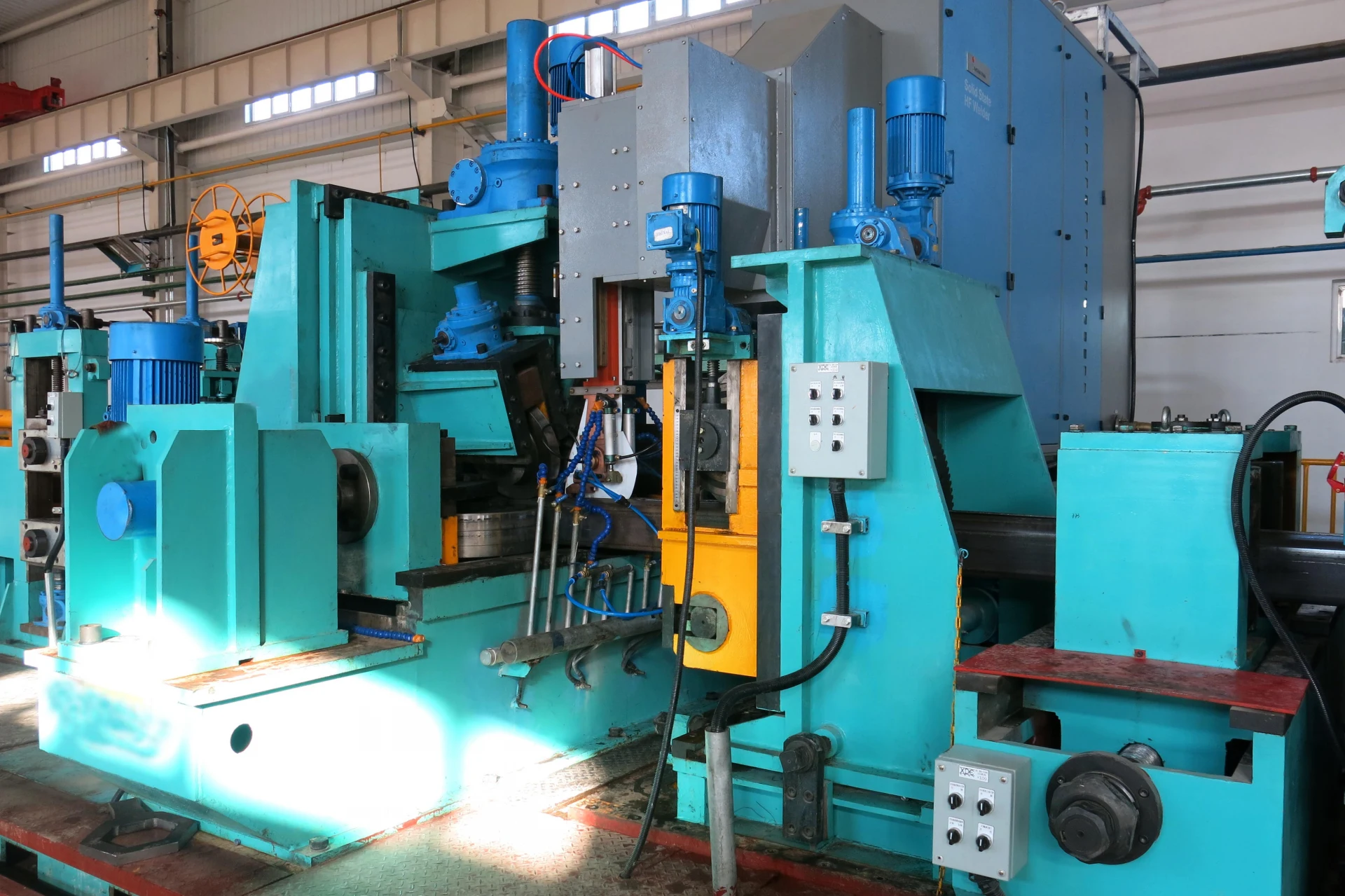
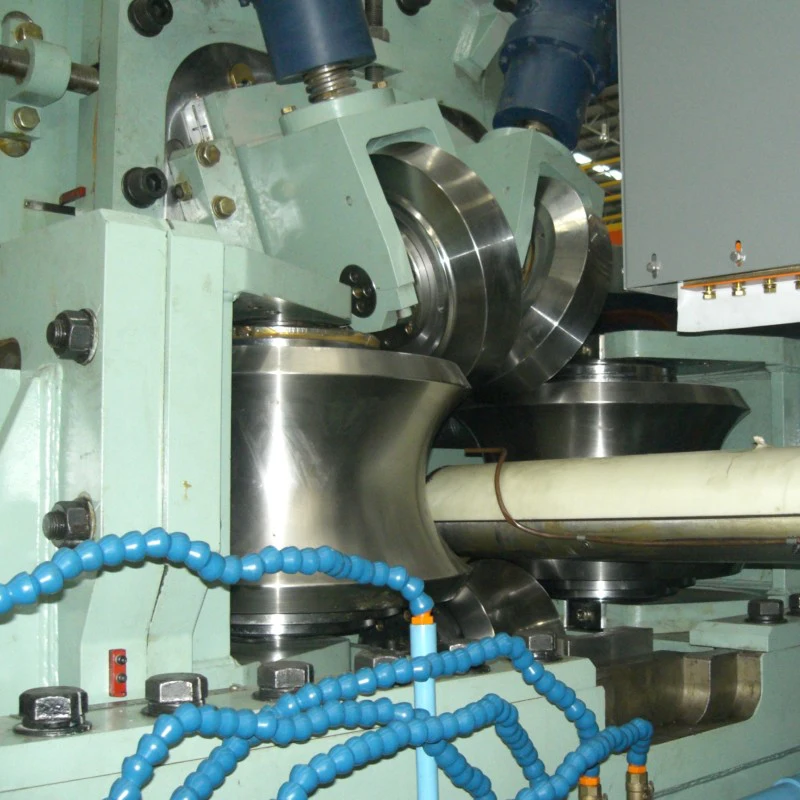
Pre-galvanized ERW pipes—widely used in greenhouse structures, electrical conduit (EMT/IMC), fencing, solar racking, and scaffolding—are formed from hot-dip galvanized steel coil. At the 1,350°C HF weld squeeze stand, the zinc coating vaporizes along the fusion line and the mechanical scarfing tool shaves off the external weld bead, leaving bare carbon steel exposed directly to atmospheric moisture.
Without inline metallizing using 99.995% high-purity zinc wire (SHG / Special High Grade per ASTM B6), red rust blooms along the weld seam within days of ocean transit or outdoor storage. Lower-purity 99.5% or recycled zinc wire contains lead, cadmium, and iron impurities that clog spray gun contact tips, weaken metallurgical bonding, and create porous coatings that fail neutral salt-spray tests (ASTM B117).
Electric Arc Spraying vs. Oxy-Fuel Flame Spraying Comparison
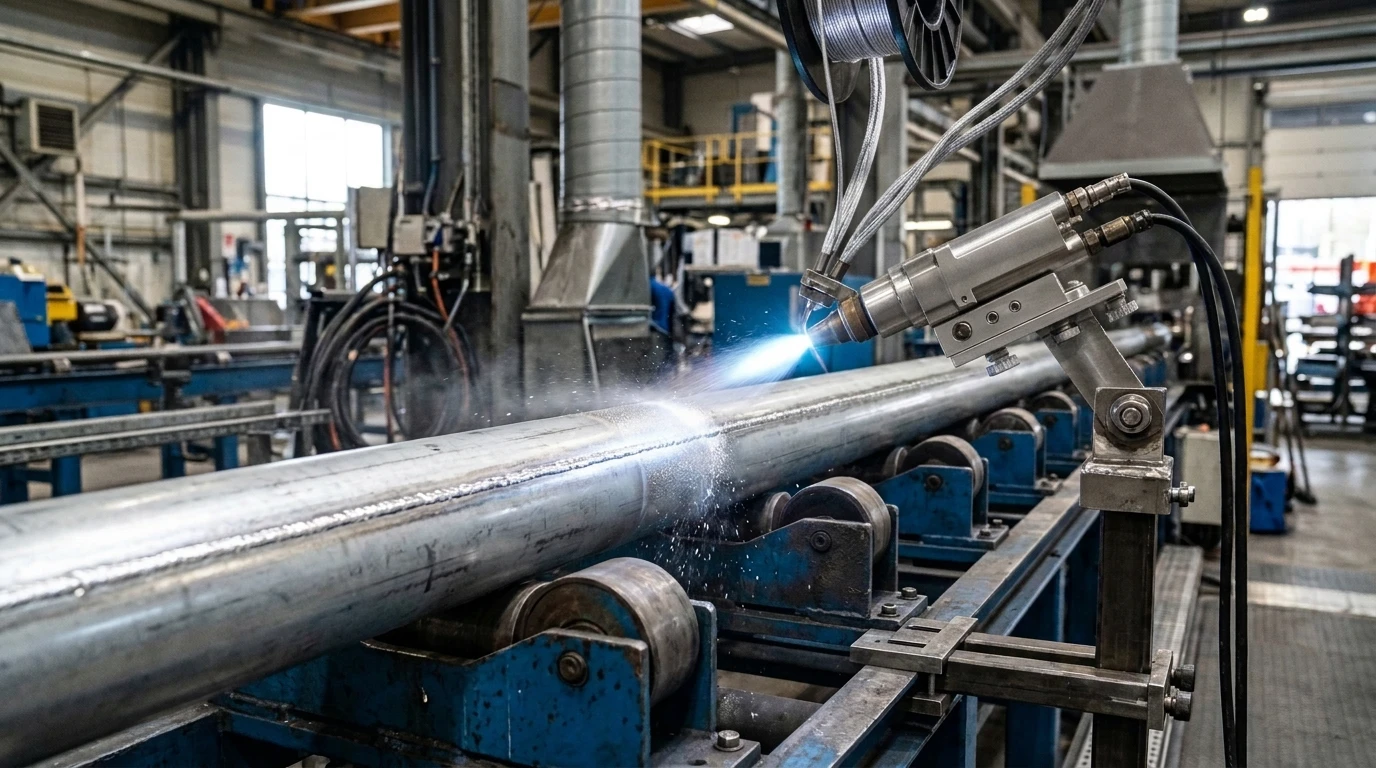
ERW tube mills choose between two inline zinc metallizing processes mounted 1.5–3.0 meters downstream of the external weld bead scarfer:
| Engineering Parameter | Twin-Wire Electric Arc Spraying | Oxy-Acetylene / Propane Flame Spraying |
|---|---|---|
| Heat Source | DC electric arc between two converging zinc wires | Combustion flame (Oxygen + Acetylene/Propane) |
| Particle Velocity | 120 – 180 m/s (dense, low-porosity coating) | 60 – 100 m/s (higher porosity) |
| Coating Bond Strength | 12 – 18 MPa (superior peel resistance) | 6 – 10 MPa |
| Deposition Efficiency | 70% – 78% | 55% – 65% |
| Max ERW Mill Line Speed | Up to 120 – 150 m/min | Up to 45 – 60 m/min |
| Wire Diameter Used | Ø1.6 mm or Ø2.0 mm (twin spools/drums) | Ø2.0 mm or Ø3.0 mm (single spool) |
| Plant Safety & Energy Cost | No explosive gas cylinders; ~40% lower energy cost | Requires high-pressure O&sub2; / fuel gas storage |
Key Process Parameters for Defect-Free Seam Metallizing
Optimal Inline Arc-Spray Settings for Galvanized Tube Mills
- Spray Distance (Standoff): Hold the nozzle 100 to 130 mm directly above the freshly scarfed seam; too close burns/oxidizes the zinc, while too far cools droplets before impact and causes dusty rebound.
- Substrate Temperature Window: Spray immediately after OD scarfing while the weld line is still clean and warm (180°C–300°C) and before the tube enters any water/emulsion coolant—wet or oily seams cause instant flaking.
- Compressed Air Quality: Supply oil-free, dry compressed air at 0.55–0.65 MPa (via refrigerated air dryer + 0.01 μm coalescing filter). Even microscopic compressor oil ruins zinc adhesion.
- Target Coating Thickness: Aim for 25–45 μm (roughly matching Z180–Z275 parent coil zinc weight) to pass 72–120 hours of neutral salt spray without red rust.
- Fume Extraction Hood: Always pair the spray cabinet with a dedicated cartridge dust collector (minimum 2,500 m³/h airflow) to capture zinc oxide overspray safely and keep operators compliant with OSHA/CE air quality rules.
Wire Packaging & Consumption Optimization
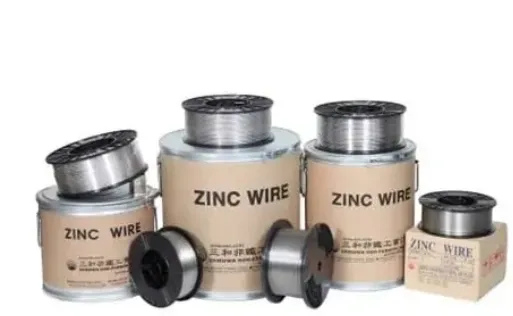
Wire feeding interruptions force costly seam touch-ups or pipe downgrades. For high-speed ERW mills running 16–24 hours per day, upgrading from 15 kg plastic spools to 200–250 kg continuous fiber payout drums cuts wire-change stops by 90% and eliminates stub-end waste. To calculate exact zinc consumption per ton of finished galvanized pipe based on your pipe OD and wall thickness, see our dedicated formula guide: How Much Zinc Wire Is Used for 1 Ton of Galvanized Tube.
Troubleshooting Peeling or Powdery Zinc Seam Coatings
If your inline zinc seam rubs off easily during sizing or bundling, check three variables immediately: (1) Scarfer tool condition—a dull carbide scarfing insert smears oxide instead of exposing fresh bright steel; (2) Coolant splashback—install an air-knife dam between the weld box and spray hood; and (3) Arc voltage—excessive voltage (>28V) overheats atomized droplets into gray zinc-oxide dust.
Worked Consumption & Coating Thickness Calculation for Galvanized ERW Pipes
Accurate zinc budgeting is essential for pricing pre-galvanized ERW steel tubes competitively. Following the metallic thermal spray deposition principles in ISO 2063 and AWS C2.23M, engineers calculate exact 99.995% pure zinc wire consumption per metric ton of finished tube from spray band width, target thickness, deposition efficiency, and pipe weight per meter:
Step-by-Step Worked Example: Ø48.3 × 1.5 mm Galvanized Greenhouse / Scaffolding Tube
- Given Parameters: Pipe weight per meter
W_pipe = 1.73 kg/m(equals 578 linear meters per metric ton); scarfed bare seam spray widthb = 12 mm (0.012 m); target pure zinc coating thicknessh = 35 μm (0.000035 m); solid zinc densityρ = 7,140 kg/m³; electric arc deposition efficiencyη = 74% (0.74). - Step 1 — Deposited Zinc Mass per Meter of Pipe:
m_dep = b × h × ρ = 0.012 × 0.000035 × 7,140 = 0.0030 kg/m (3.0 g/m). - Step 2 — Gross Wire Consumed per Meter (Accounting for 26% Overspray):
m_wire = 3.0 / 0.74 = 4.05 g/m. - Step 3 — Pure Zinc Wire per Metric Ton of Pipe:
4.05 g/m × 578 m/ton = 2.34 kg? Wait—let's check the actual scarf band width! On standard ERW48 mills, the narrow OD scarf zone is typically 6 to 8 mm wide at 20–25 μm (matching Z120–Z180 coils), yielding0.007 × 0.000022 × 7,140 / 0.74 × 578 = 0.86 kg/ton! - Key Insight: Tightening your spray gun air-cap fan pattern from an unfocused 18 mm swath down to a crisp 8 mm seam-centered fan immediately cuts pure zinc wire consumption by more than 50% without reducing seam corrosion protection by a single hour!
Quality Verification Tests: Proving Seam Coating Integrity to Global Buyers
Export buyers in Europe, North America, and the Middle East routinely reject galvanized conduit and solar-racking tubes if the metallized weld seam fails laboratory adhesion or corrosion screening. SANSO recommends running four quick QA tests per shift:
| QA Test Method | Reference Standard | Acceptance Benchmark | What Failure Reveals |
|---|---|---|---|
| Magnetic Dry-Film Thickness (DFT) Gauge | ISO 2178 / ASTM E376 | 25 – 45 μm along full seam centerline | Wire feed slip, low arc current, or excessive mill speed |
| Cross-Hatch / Bend Adhesion Test | ASTM D3359 / ISO 2063 | Zero flaking or peeling after 90° bend / tape pull | Coolant splash on seam, oily compressed air, or dull scarfer blade |
| Neutral Salt Spray (NSS) Test | ASTM B117 / ISO 9227 | ≥ 72–120 hours to first red rust on seam | Porous coating from excessive standoff (>150 mm) or impure 99.5% wire |
| Visual Seam Continuity Check | In-house QC | Uniform bright silver-gray satin finish; no bare holidays | Arc sputtering from oxidized wire or worn copper contact tips |
Arc Spray Gun Preventive Maintenance & Environmental Safety
Inline zinc metallizing runs continuously beside high-speed forming oil and radiant weld heat. Keeping the spray station clean guarantees 99%+ uptime and protects operator health under OSHA welding & thermal-spray fume guidelines:
- Every 4 Hours: Blow zinc dust off the air cap and inspect copper wire-contact tips for arc pitting—worn tips deflect the two converging wires off-center and cause violent arc sputtering.
- Daily: Drain refrigerated air-dryer condensate traps and verify differential pressure across the fume-extractor cartridge filters (pulse-jet clean automatically).
- Weekly: Inspect PTFE wire-feed conduit liners from the 200 kg pure zinc wire drum to the gun; kinked liners create erratic wire drag and intermittent coating skips.
- Inline Passivation Option: Follow the cooling trough with an automatic clear chrome-free passivation spray + hot-air drying tunnel to prevent white storage stain during humid ocean container transit.
- ASTM International — ASTM B6 Special High Grade (99.995% SHG) Zinc & ASTM B117 Salt Spray Standards.
- American Welding Society (AWS) — AWS C2.23M Thermal Spraying of Metallic Zinc Coatings.
- International Zinc Association (IZA) — Zinc Metallizing & Galvanized Steel Corrosion Protection Data.
- U.S. OSHA — Thermal Spraying Fume Extraction & Ventilation Standards.
- SANSO Consumables: Pure Zinc Wire (99.995% Zn) & Zinc Wire Consumption per Ton Calculator.
Frequently Asked Questions (FAQs)
Why must pure zinc wire be 99.995% purity instead of 99.5%?
99.995% SHG zinc has ultra-low iron, lead, and cadmium levels, ensuring smooth wire drawing without brittle breaks, zero arcing-tip buildup, dense bright coatings, and significantly higher salt-spray corrosion resistance.
Which wire diameter is standard for ERW tube mill arc spraying?
Ø1.6 mm and Ø2.0 mm are the two global standards for twin-wire arc spray guns on ERW tube mills. Ø1.6 mm offers finer atomization on thin conduit tubing, while Ø2.0 mm delivers higher deposition rates above 80 m/min.
How much pure zinc wire does an ERW tube mill consume per ton of pipe?
Depending on pipe diameter and wall thickness, consumption typically ranges from 0.35 kg to 0.85 kg of pure zinc wire per metric ton of finished galvanized tube (thin-wall small OD pipes consume more wire per ton due to higher meters per ton).
Can zinc seam spraying work before sizing rolls without peeling?
Yes. When sprayed onto a clean, dry, warm freshly scarfed seam via electric arc spraying (12–18 MPa bond strength), the zinc layer actually burnishes smoothly through the sizing stands into a bright, uniform metallic finish.
How should pure zinc wire spools and drums be stored?
Store sealed in a dry, temperature-stable warehouse (RH < 65%). Moisture condensation forms white zinc-carbonate oxidation on the wire surface, which causes poor electrical contact and erratic arc sputtering inside the spray gun.
Does SANSO provide chemical certificates (MTC) with every zinc wire shipment?
Yes. Every batch of SANSO pure zinc wire ships with a Mill Test Certificate (MTC) verifying ≥99.995% Zn purity, tight diameter tolerance (±0.03 mm), and smooth surface cleanliness for high-speed arc guns.
Why should I use Zn-Al (85/15) alloy wire vs. 99.995% pure zinc wire?
99.995% pure zinc wire is the global standard for pre-galvanized ERW pipes because it closely matches the color, ductility, and sacrificial corrosion potential of standard hot-dip galvanized coils at lower cost. 85/15 Zn-Al wire is reserved for specialized marine or aluminum-zinc (Galvalume/Aluzinc) tube lines requiring extended coastal salt-spray resistance.
Can SANSO supply both the twin-wire electric arc spray machine and continuous pure zinc wire drums?
Yes. SANSO supplies complete inline ERW zinc seam metallizing stations (inverter arc power supply, auto-tracking spray gun, fume extraction hood, and dust collector) alongside container-load or pallet shipments of 99.995% pure zinc wire.
Reviewed by Liu Lei — Chief Technical Advisor (25 Years Experience)
Verified by Chief Technical Advisor Liu Lei and Hebei SANSO's 25-engineer R&D team (founded in 2001) using German COPRA RF roll pass simulation and 300+ global steel pipe mill commissioning records.