Engineering Overview
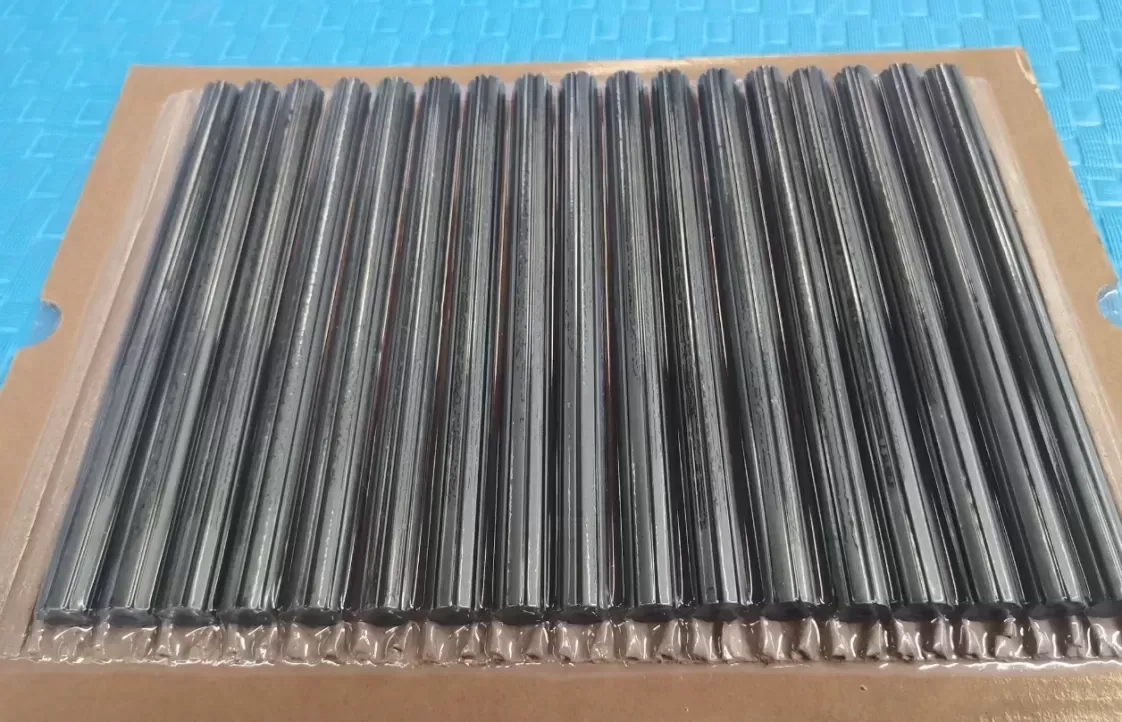
The SANSO ERW Tube Mill Impeder is a precision-engineered magnetic flux concentrator placed inside the open-seam steel tube beneath the high-frequency induction coil. By raising the impedance of the inside tube wall path, the impeder forces HF welding current directly onto the strip V-edges—reducing HF welder energy consumption by 15–25%, increasing line speed, and eliminating cold welds.
Key Engineering Features & Advantages
- Through-Flow & Return-Flow Architectures: Through-flow impeders discharge coolant out the nose for maximum cooling in general mills; return-flow impeders keep the weld zone dry for ID scarfing and specialized alloy tubes.
- Heat-Resistant Epoxy-Glass & Ceramic Casings: High-strength wound fiberglass shells withstand mechanical abrasion from moving tube seams, molten weld spatter, and continuous thermal cycling.
- Clustered Multi-Rod Core Design (Large ID): For large-diameter mills (ERW114–ERW426), clustered multi-rod ferrite cartridges maximize magnetic cross-section while maintaining vigorous coolant channels.
- Plug-and-Play Replacement Assemblies: Supplied complete with non-magnetic stainless/brass threaded couplings, casing sleeves, and spare ferrite cores for fast mill-floor swaps.
Technical Specifications
| Impeder Type | Recommended Tube OD | Coolant Discharge | Primary Advantage |
|---|
| Through-Flow (SS-IMP-TF) | Ø12 – Ø165 mm | Open nose toward squeeze rolls | Maximum ferrite cooling efficiency & simplest maintenance |
| Return-Flow (SS-IMP-RF) | Ø25 – Ø219 mm | Closed nose, returns to entry | Keeps interior dry for ID bead scarfing & stainless tubing |
| Clustered Heavy-Duty | Ø165 – Ø508 mm | Through-flow or Return-flow | High flux capacity for heavy-wall structural & API pipes |
Process Flow & System Configuration
Connect impeder coupling to non-magnetic mandrel rod → Verify ≥3 bar clean filtered coolant flow → Align impeder tip 3–6 mm past the squeeze roll centerline → Monitor HF welder kW/frequency ratio for peak impedance efficiency.
Frequently Asked Questions
How much power does a properly sized impeder save in an ERW tube mill?
Operating an ERW mill with a correctly sized, well-cooled impeder typically cuts solid-state HF welder power draw by 15% to 25% compared to undersized or thermally degraded impeders, while enabling higher line speeds.
How should the impeder be positioned relative to the HF coil and squeeze rolls?
The ferrite core should span the entire induction coil length and extend approximately 3–6 mm beyond the centerline of the weld squeeze rolls toward the weld point for optimal V-apex heating.
When should I choose a return-flow impeder over a through-flow impeder?
Choose a return-flow impeder when producing small/medium pipes requiring internal weld bead scarfing, stainless steel tubes, or when discharge water inside the tube interferes with downstream testing.

 1 / 3