Hopper Feeder for Flux & Solid Cored Wire Production Line: Functions, Specs & Configurations
Quick Answer: In a flux and solid cored wire production line, the hopper feeder is the precision dosing subsystem that meters alloy or flux powder into the pre-formed U-shaped steel strip at a rate electronically synchronized with line speed. Using a servo-driven planetary reducer, OMRON preforming encoder linkage, KEYENCE laser level monitoring, and real-time loss-in-weight control, SANSO hopper feeders maintain uniform powder fill density across acceleration, steady-state, and deceleration stages.
Key Engineering Takeaways
- Speed-Synchronized Dosing: An OMRON encoder on the preforming unit links servo dosing directly to strip velocity, preventing under-filling during ramp-up or over-filling at low speed.
- Dual-Verification Accuracy: Real-time loss-in-weight load cells work alongside imported KEYENCE laser height sensors to verify both mass flow (g/m) and powder levelness inside the U-channel.
- Zero-Contamination Hopper Design: Four removable 304 stainless steel hoppers (≥0.3 m³ each) mounted on vibration-damping rubber supports prevent rust, magnetic clumping, and alloy cross-contamination.
- Two Industrial Layouts: Available in Side-by-Side multi-hopper arrangement (layered multi-component dosing) or Vertical Stacked belt arrangement (pre-blended fine + coarse powders).
Why Hopper Feeder Precision Determines Cored Wire Quality
Metallurgical cored wires—such as calcium-silicon (CaSi), pure calcium, ferro-titanium, and carbon-cored wires—are injected deep into molten steel ladles for deoxidation, desulfurization, and inclusion modification. If powder fill weight fluctuates along the coil length, steelmakers suffer inconsistent alloy recovery and unpredictable ladle chemistry.
In a high-speed composite cored wire production line, the hopper feeder bridges raw powder storage and strip closing. Its engineering mission is to guarantee that the set bulk density on the dispenser matches the actual powder mass per linear meter exiting the final calibration stand.
Core Functions of the SANSO Cored Wire Hopper Feeder
1. Servo Motor & Planetary Precision Reducer Drive
Each feeder station is driven by a 0.75 kW DELTA servo motor coupled to a high-rigidity FENG HUA (Taiwan) planetary precision reducer. Working in concert with the precision feeding gate, the servo drive delivers smooth, backlash-free torque so alloy powder flows steadily into the U-shaped steel strip without surging or bridging.
2. Coordinated Dual-Hopper Operation via SIEMENS PLC
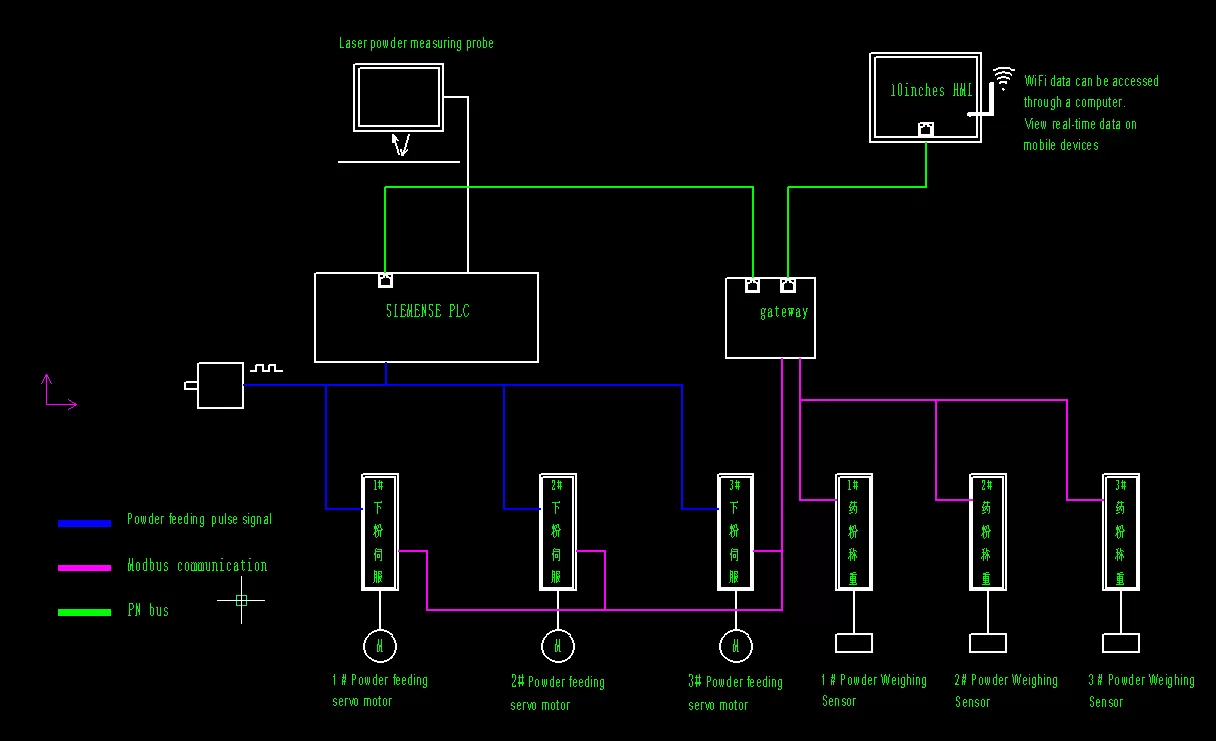
For multi-component alloy wires, two or more hopper feeders operate in closed-loop coordination under a central SIEMENS PLC. Operators configure target fill ratios, monitor live alarms, and adjust calibration offsets directly from a 10-inch color KUNLUN TONGTAI HMI touchscreen.
3. Preforming Encoder Linkage & Loss-in-Weight Control
An OMRON rotary encoder mounted on the strip preforming unit tracks exact strip velocity in real time and locks the feeder's dosing speed to the forming line. Simultaneously, an integrated loss-in-weight weighing system continuously measures the real-time weight decrease inside the hopper to calculate exact powder mass per meter of wire—guaranteeing stable qualification rates across every coil.
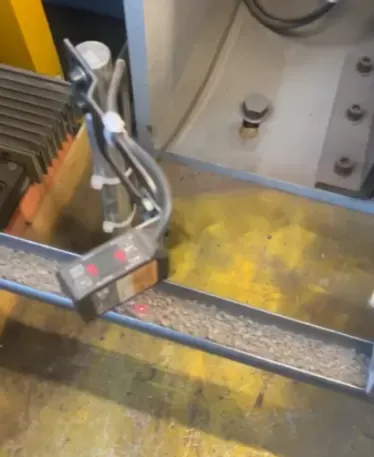
4. Imported KEYENCE Laser Level Detection
To prevent hidden voids or uneven powder distribution inside the U-shaped strip, SANSO equips the feeder with an imported KEYENCE laser sensor. The sensor scans powder height and levelness inside the open U-channel and plots a live trend curve on the HMI screen. Operators can set a minimum powder threshold alarm to halt or flag the line immediately if powder bridging or hopper depletion occurs.
5. 304 Stainless Steel Hopper & Micrometer Gate Adjustment
All powder-contacting hoppers are fabricated from AISI 304 stainless steel, providing corrosion resistance and strictly non-magnetic walls so ferromagnetic alloy powders do not cling to the chute. The discharge gate uses a micrometer-head adjustment mechanism with a positive locking device, enabling repeatable, parameterized gate settings when switching between wire diameters or powder meshes.
6. Dynamic Powder Filling Curve Compensation
Conventional feeders suffer from fill-rate drift whenever a production line accelerates from threading speed to full operating speed. SANSO's proprietary powder filling curve control system automatically applies speed-dependent compensation across acceleration, steady-state high-speed, low-speed, and deceleration regimes—eliminating powder loss variation from the first meter to the last.
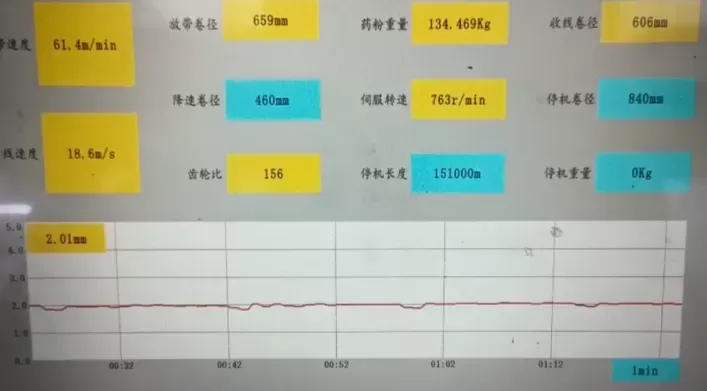
7. Real-Time HMI Monitoring Dashboard
The electrical control cabinet touchscreen displays all critical dosing diagnostics on a single operator interface:
- Live residual filler (powder) weight inside each hopper
- Low-level / insufficient powder acoustic and visual alarms
- Real-time steel strip forming speed (m/min)
- Dispenser drive running speed and servo torque
- Calculated powder filling mass per linear meter (g/m)
- System fault diagnostics and interlock status
Electrical Control System & Dosing Diagrams
The diagrams below illustrate SANSO's closed-loop electrical control architecture, PLC/HMI signal flow, and synchronized servo-weighing feedback used on flux and solid cored wire lines:
Two Hopper Feeder Configurations: Side-by-Side vs. Vertical Dispenser
SANSO supplies two distinct mechanical layouts so wire producers can match the feeder architecture to their powder particle size distribution and alloy formulation:
| Feature | Option 1: Side-by-Side Multi-Hopper | Option 2: Vertical Stacked Belt Dispenser |
|---|---|---|
| Mechanical Layout | Two or more hopper feeders arranged sequentially along the forming pass line | Two filling belts arranged vertically—fine powder on upper belt, coarse powder on lower belt |
| Powder Distribution | Distinct sequential layered zones inside the U-shaped steel billet | Pre-blended mixture (fine powder sprinkled evenly onto coarse particles before strip entry) |
| Best Suited For | Two-component reactive alloys requiring separated dosing calibration | Multi-mesh flux or composite powders prone to segregation by particle size |
| Calibration Method | Independent per-dispenser 1-meter sample weighing | Synchronized dual-belt ratio control with laser height verification |
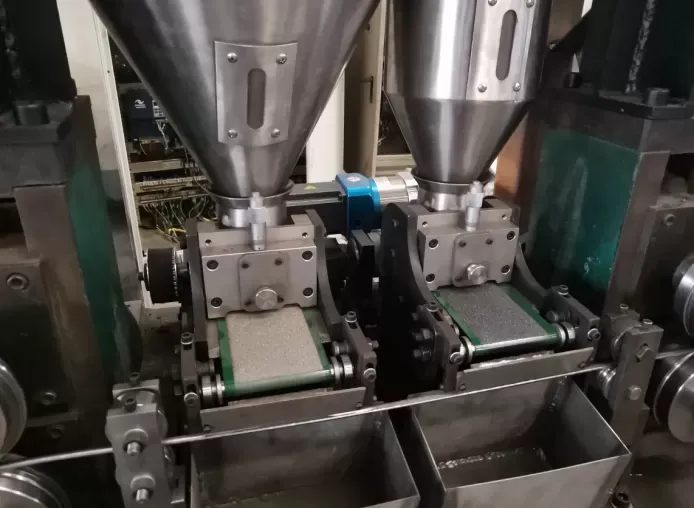
Option 1: Side-by-Side Multi-Hopper Arrangement
Two or more hopper feeders are positioned side by side along the preforming table to feed different alloy powders sequentially into the U-shaped steel strip. Each powder occupies a controlled, repeatable layer inside the finished cored wire.
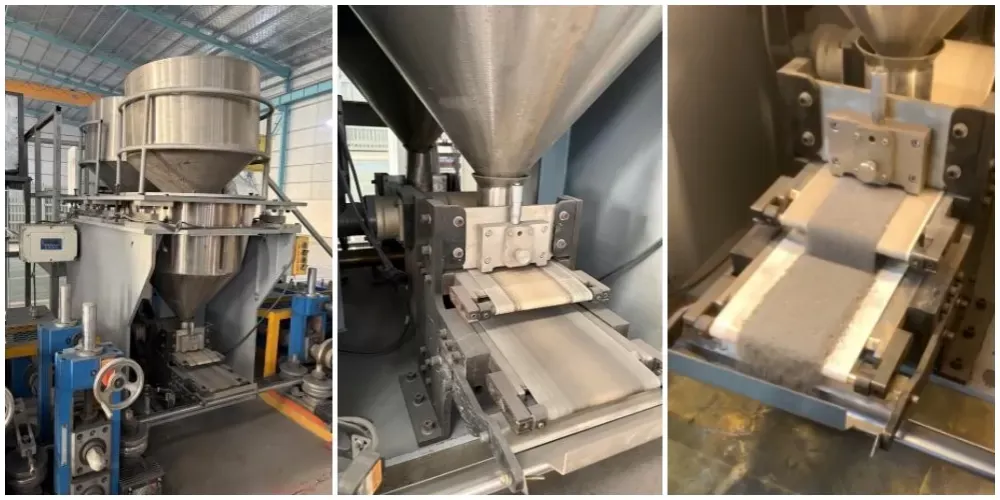
Option 2: Vertical Stacked Dispenser
Two conveying belts are stacked vertically: fine-mesh powder is metered onto the upper belt while coarse granular powder travels on the lower belt. As the fine powder sprinkles evenly over the coarse base layer, the homogenized blend enters the U-channel cleanly with minimal dust and zero size segregation.
Bought-Out Brand Components Specification
To ensure long-term industrial reliability and global spare-parts availability, SANSO builds every cored wire hopper feeder with Tier-1 automation and motion components:
| Subsystem / Component | Specification | Brand / Origin |
|---|---|---|
| Servo Motor | 0.75 kW high-response AC servo | DELTA |
| Servo Planetary Reducer | Precision low-backlash planetary gearhead | FENG HUA (Taiwan) |
| Linear Guide Rails & Slides | Heavy-duty hardened precision rails | AANTE |
| Preforming Line Encoder | High-resolution rotary speed encoder | OMRON |
| Main Logic Controller (PLC) | Industrial modular PLC | SIEMENS |
| Operator Touch Screen (HMI) | 10-inch industrial color touchscreen | KUNLUN TONGTAI |
| Powder Level Laser Sensor | High-precision optical height/levelness sensor | KEYENCE |
| Bearings | Precision industrial rolling bearings | FAG |
Key Mechanical Design Features & Calibration Procedure
Beyond automation controls, SANSO incorporates five structural design features required for continuous 24/7 metallurgical wire plants:
- Four Removable Quick-Change Hoppers (≥0.3 m³ Each): Four interchangeable stainless steel hoppers allow rapid alloy changeover without shutting down the line for extended washouts.
- Two-Component Sequential Calibration Protocol: When producing two-component cored wire, Dispenser #2 is calibrated first (with Dispenser #1 closed) by running the line to operating speed, stopping, and weighing 1 linear meter of wire and its powder contents. Once Component 1 meets target g/m, Dispenser #1 is opened and the 1-meter verification is repeated to lock in total fill weight.
- Rubber-Isolated Stainless Mounting & Maintenance Shutoff: Each receiving hopper is fabricated from stainless steel, mounted on vibration-damping rubber supports, and fitted with a positive shutoff mechanism to interrupt filler flow safely during dispenser maintenance.
- Uniform Intake & Stepless Adjustment: The dispenser geometry guarantees steady powder intake across all operating speeds with smooth, stepless flow-rate adjustment.
- Post-Compaction Gutter Shelf Cleaning Units: Dedicated cleaning units strip residual powder from the U-channel gutter shelves after compaction, ensuring a clean lock-seam fold and preventing powder leakage during final sizing.
Worked Dosing Math: Calculating Loss-in-Weight Powder Fill Rate (g/m)
In metallurgical flux and composite cored wire manufacturing (used globally in secondary ladle refining per World Steel Association clean-steel practices), wire buyers specify strict linear powder mass (g/m) and filling ratio percentage. SANSO's SIEMENS PLC continuously verifies actual mass flow using the closed-loop loss-in-weight equation:
Step-by-Step Worked Dosing Example: Ø13 mm CaSi30 Cored Wire at 120 m/min
- Target Product Spec: Ø13.0 mm cored wire with
240 g/mcalcium-silicon alloy powder inside a 0.40 mm × 44 mm SPCC steel strip (strip weight~138 g/m→ total wire weight378 g/m, powder fill ratio63.5%). - Step 1 — Required Mass Flow Rate at 120 m/min:
M_dot = 240 g/m × 120 m/min = 28,800 g/min = 28.8 kg/min (1,728 kg/hr). - Step 2 — Hopper Refill Interval (0.3 m³ 304 Stainless Hopper): At CaSi bulk density
~1.45 t/m³, one 0.3 m³ hopper holds~435 kgof powder → runs ~15 minutes per hopper (or seamless continuous production when using SANSO's 4 quick-change removable hoppers + overhead vacuum/screw autoloader). - Step 3 — Closed-Loop PLC Correction: Every 2 seconds, the load cells compare actual weight loss against
OMRON Encoder Meters × 240 g/m. If bulk density shifts by 3%, the PLC automatically trims the 0.75 kW DELTA servo RPM while the KEYENCE laser sensor confirms U-channel fill height stays safely below the closing-roll pinch line.
Shop-Floor Troubleshooting Matrix for Cored Wire Hopper Feeders
| Dosing / Wire Defect | Root Mechanical or Sensor Cause | Immediate Operator Correction |
|---|---|---|
| Low powder fill weight during mill acceleration | Powder filling curve compensation coefficient set too low in HMI | Tune acceleration feed-forward curve (+3%–6%) on 10-inch KUNLUN TONGTAI HMI and re-verify 1 m sample |
| Powder bridging / rat-holing inside hopper | Damp hygroscopic flux powder or static clumping | Verify powder moisture (<0.3%), inspect 304 stainless non-magnetic hopper wall grounding & rubber isolator vibrator |
| Seam leaks powder after closing stands | Over-filled U-channel or worn post-compaction gutter shelf cleaner | Check KEYENCE laser height limit, adjust micrometer gate down 0.2 mm, and replace shelf cleaning brush/scraper |
| Erratic load-cell weight readings | Mechanical hose bind or forming-mill vibration leaking into weighing frame | Check rubber vibration-isolation mounts and ensure flexible discharge chutes do not pull on the weigh frame |
- World Steel Association — Secondary Ladle Metallurgy & Cored Wire Alloy Injection Standards.
- ASM International — Metallurgical Cored Wire Formulations & Powder Flow Mechanics.
- IEC — Industrial PLC & Closed-Loop Gravimetric Dosing Control Standards (IEC 61131).
- ASTM International — Ferroalloy & Metallurgical Powder Particle Size Testing Standards.
- SANSO Cored Wire Machinery: Solid Calcium Cored Wire Line & Composite Cored Wire Line.
Frequently Asked Questions (FAQ)
How does the hopper feeder keep powder fill weight consistent when line speed changes?
An OMRON rotary encoder on the preforming unit feeds real-time strip velocity to the SIEMENS PLC, which automatically adjusts the DELTA servo motor speed using SANSO's dynamic powder filling curve. This eliminates fill-rate drop during acceleration and deceleration.
Why are SANSO cored wire hoppers built from 304 stainless steel?
304 stainless steel is both corrosion-resistant and non-magnetic. Non-magnetic walls prevent iron-bearing or alloy powders from sticking or bridging inside the chute, while corrosion resistance protects the hopper from hygroscopic flux materials.
How is a two-component cored wire hopper feeder calibrated before production?
Operators run Dispenser #2 alone at target line speed, cut and weigh a 1-linear-meter wire sample to verify Component 1 mass, and then open Dispenser #1 and repeat the 1-meter sample check until total powder bulk mass exiting the final calibration stand matches specification.
When should I choose a vertical dispenser instead of side-by-side hoppers?
Choose the vertical stacked dispenser when blending fine and coarse powders that tend to segregate in a single bin. Choose the side-by-side multi-hopper layout when dosing two distinct alloy components that must remain cleanly calibrated as separate layers.
Can SANSO supply a complete flux or solid calcium cored wire production line?
Yes. Hebei SANSO Machinery manufactures complete turnkey solid calcium cored wire production lines and composite cored wire lines including uncoilers, forming mills, servo hopper feeders, closing stands, and automatic take-up coilers. Contact our engineering team for a custom line specification.
Reviewed by Liu Lei — Chief Technical Advisor (25 Years Experience)
Verified by Chief Technical Advisor Liu Lei and Hebei SANSO's 25-engineer R&D team (founded in 2001) using German COPRA RF roll pass simulation and 300+ global steel pipe mill commissioning records.